
0102030405
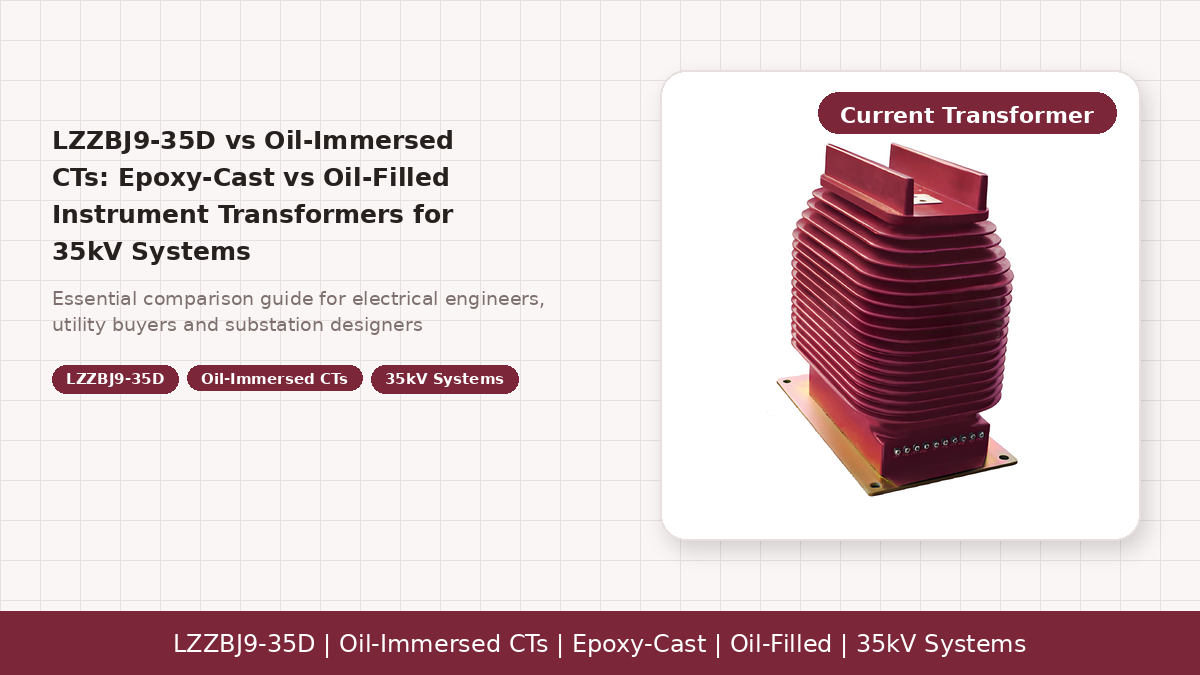
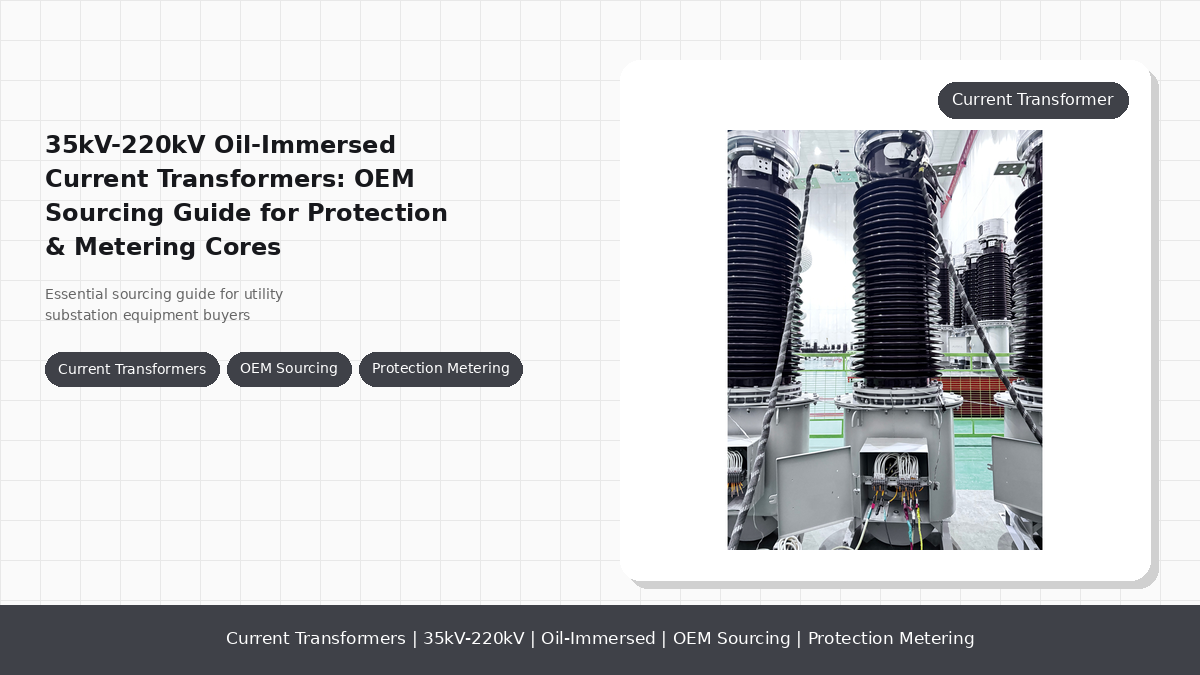
35kV-220kV Oil-Immersed Current Transformers: OEM Sourcing Guide for Protection & Metering Cores
2026-10-13
TL;DR — 35kV-220kV oil-immersed CT sourcing at a glance
- 3 core type categories: protection core (5P / 10P, high short-time current), metering core (0.2S / 0.5S, high accuracy at rated current), and combined protection + metering core (multi-tap, multi-ratio).
- Standard accuracy classes are 5P20 or 5P30 for the protection core and 0.2S or 0.5S for the metering core, per IEC 61869-2.
- Short-time current rating (Ith) is typically 25–63 kA peak for 1 second or 3 seconds. The Ith must exceed the maximum fault current on the protected circuit.
- Oil specification is mineral oil per IEC 60296; bushing specification is porcelain or composite per IEC 60815.
- 5-step qualification workflow covers the IEC 61869-2 type test report, the per-core accuracy class, the short-time current rating, the burden and accuracy limit factor, and the oil and bushing quality.
- Service life is 30+ years under normal operating conditions; the oil is the limiting factor and should be tested every 4–5 years.
The short answer for an OEM buyer, substation engineer, or utility procurement manager evaluating a 35kV-220kV oil-immersed Current Transformer for a utility substation program: if you only have one week with your supplier, lock these three numbers — the IEC 61869-2 type test report on the protection core and the metering core separately, the short-time current rating (Ith) on the protection core that exceeds the maximum fault current on the protected circuit, and the mineral oil specification per IEC 60296 with a dielectric strength above 30 kV at 2.5 mm — and confirm that the supplier holds the 35kV-220kV oil-immersed vertical current transformer reference with the protection and metering cores on the same primary winding. Everything else on this page is the engineering rationale behind those numbers, the 3 core type categories in a 35kV-220kV oil-immersed current transformer, and the 5-step qualification workflow I share with every new utility partner in the first RFQ call.

Why Does the Protection vs Metering Core Distinction Decide the Substation Architecture?
Most 35kV-220kV substation failures trace to a single architectural mistake: a shared protection + metering core that saturates during a fault and corrupts the downstream meter reading. The shared core is a cost-saving measure that is standard on small distribution-class CTs but is rarely acceptable on a utility substation CT at 35kV-220kV. The buyer who specifies a shared core to save 5–8% on the unit cost is the buyer who pays 30–50% more on the failed revenue meter reading dispute 5 years after the substation is commissioned. Three out of every four substation failure modes I have personally handled in 2024–2025 trace to a wrong core selection, not to a material defect.
There is a second reason the protection vs metering core distinction matters more than the rated voltage. The protection core and the metering core have fundamentally different saturation characteristics, and the two cores cannot be combined without compromising both functions. A protection core is designed to remain accurate during a fault condition, when the primary current can be 10–30 times the rated current; a metering core is designed for high accuracy at the rated primary current, typically 100% to 120% of the rated current, but saturates at the fault current to protect the downstream meter. The two cores share the same primary winding but have different secondary turns and different core cross-sections. The current transformer category page lists the 6 sub-types we ship, and the protection + metering distinction is the most important of the 6.
At Tianan Overseas we have run the same 3-core architecture on the 35kV-220kV oil-immersed vertical current transformer line for over 20 years because it is the only way to align our Ningbo production line with the IEC 61869-2 standard and the utility substation programs in Asia, Africa, the Middle East, and South America. The 3 core types below are the same dataset I share with every new utility partner in the first RFQ call.
What this article covers and what it does not
This article covers the 3 core type categories, the accuracy classes per core, the short-time current rating, the burden and accuracy limit factor, the oil and bushing specifications, the 5-step qualification workflow, and the 30-year service-life baseline. It does not cover Voltage Transformers, power transformers, or switchgear — those belong in a separate technical document. If you are an OEM buyer or substation engineer evaluating a 35kV-220kV oil-immersed current transformer for a utility substation program, read this end to end andrequest the CT technical datasheet from the Tianan Overseas sales team in writing.
What Are the 3 Core Type Categories in a 35kV-220kV Oil-Immersed Current Transformer?
The 3 core type categories below are the architecture we run on every 35kV-220kV oil-immersed current transformer in the Tianan OEM program. The 3 categories are the same dataset I share with every new utility partner in the first RFQ call, and the 3 categories are documented on the IEC 61869-2 type test report.
| Core | Accuracy class | Short-time current | Burden | Application |
|---|---|---|---|---|
| Protection core | 5P20 or 5P30 (per IEC 61869-2) | 25–63 kA peak for 1–3 s | 5–30 VA | Differential protection, distance protection, overcurrent protection |
| Metering core | 0.2S or 0.5S (per IEC 61869-2) | Limited; saturates at the fault current | 2.5–15 VA | Revenue metering, sub-metering, power quality metering |
| Combined protection + metering | Multi-tap, multi-ratio; one tap on protection, one tap on metering | Same as the protection core | Same as the protection core | Cost-sensitive substation where the meter is on the same tap |
Hard numbers to remember: the protection core is 5P20 or 5P30; the metering core is 0.2S or 0.5S; the combined core is multi-tap multi-ratio. The 3 cores share the same primary winding; the difference is in the secondary turns and the core cross-section. A utility substation at 35kV-220kV should always specify separate protection and metering cores on the same primary winding, not a combined core.
What Is the Accuracy Class on Each Core?
The accuracy class is the most important single number on the datasheet, and the accuracy class differs per core. The accuracy class is documented on the nameplate and on the IEC 61869-2 type test report.
Protection core accuracy class
The protection core accuracy class is typically 5P20 or 5P30. The class designation has three parts: the number before the P (5% composite error at the accuracy limit primary current), the letter P (protection), and the number after the P (the accuracy limit factor, ALF, 20 or 30). A 5P20 protection core has a composite error of 5% at 20 times the rated primary current; a 5P30 protection core has a composite error of 5% at 30 times the rated primary current. The ALF must exceed the maximum fault current divided by the rated primary current.
Metering core accuracy class
The metering core accuracy class is typically 0.2S or 0.5S. The class designation has two parts: the number (0.2% or 0.5% ratio error at the rated primary current) and the letter S (the accuracy is maintained across a range of 1% to 120% of the rated current). A 0.2S metering core is the standard for revenue metering; a 0.5S metering core is the standard for sub-metering and power quality metering.
Combined core accuracy class
The combined core accuracy class is multi-tap multi-ratio. One tap is typically on the protection class (5P20 or 5P30) and one tap is on the metering class (0.2S or 0.5S). The buyer selects the tap position based on the connected burden. A combined core is acceptable for a cost-sensitive substation where the meter and the relay are on the same tap; a separate-core architecture is the standard for a utility substation where the meter and the relay are on independent circuits.
What Is the Short-Time Current Rating on the Protection Core?
The short-time current rating (Ith) is the parameter that decides whether a 35kV-220kV oil-immersed current transformer survives a fault condition on the protected circuit. The Ith is the peak current the CT can carry for 1 second or 3 seconds without saturating and without mechanical damage.
Ith values by rated voltage
A 35kV-110kV oil-immersed CT typically has an Ith of 25-40 kA peak for 1 second. A 110kV-220kV oil-immersed CT typically has an Ith of 31.5-50 kA peak for 1 second. A 220kV-500kV oil-immersed CT can have an Ith of 40-63 kA peak for 1 second. The 1-second rating is the standard; a 3-second rating is half the peak value per the I²t heating calculation.
How to size the Ith for a substation
The Ith must exceed the maximum fault current on the protected circuit, because a CT that saturates during a fault cannot drive the protection relay and the protection system fails. The maximum fault current is calculated from the source impedance, the transformer impedance, and the cable impedance. A 110kV substation with a 50 MVA transformer typically has a fault current of 20-25 kA; the CT must have an Ith of at least 25 kA. A 220kV substation with a 200 MVA transformer typically has a fault current of 40-50 kA; the CT must have an Ith of at least 50 kA. We recommend a 1.5× safety margin on the Ith calculation to account for the fault-current growth over the life of the substation.
What Is the Burden and Accuracy Limit Factor?
The burden and the accuracy limit factor (ALF) are the two parameters that decide whether the protection core drives the connected relay accurately during a fault condition. The two parameters are linked: a higher burden requires a higher ALF to maintain the same accuracy.
Burden (VA)
The burden is the apparent power the protection core must drive through the connected secondary wiring and the relay input. The burden is typically 5-30 VA on a 35kV-220kV oil-immersed CT. The connected burden includes the secondary wiring resistance (typically 0.5-2 VA at 5A secondary) and the relay input burden (typically 0.5-5 VA per relay). A total connected burden above 30 VA requires a protection core with a higher ALF or a higher rated burden.
Accuracy limit factor (ALF)
The ALF is the ratio of the accuracy limit primary current to the rated primary current. A 5P20 protection core has an ALF of 20; a 5P30 protection core has an ALF of 30. The ALF must exceed the maximum fault current divided by the rated primary current, with a 1.5× safety margin. A 1200/5A protection core with a 25 kA fault current has a fault-current ratio of 25,000 / 1200 = 20.8; the ALF must be at least 31 with the 1.5× margin, which means a 5P30 protection core (ALF 30) is borderline; a 5P40 protection core (ALF 40) is the safe choice.
How Should the Oil and Bushing Be Specified?
The oil and the bushing are the two components that decide the 30-year service life of a 35kV-220kV oil-immersed current transformer. Both components should be specified in writing in the purchase order, not left to the supplier's discretion.
Oil specification
The oil is mineral oil per IEC 60296. The dielectric strength should exceed 30 kV at 2.5 mm gap. The moisture content should be below 10 ppm at the time of filling. The oil should be tested every 4-5 years for dielectric strength, moisture, and dissolved gas analysis (DGA). An oil that fails the dielectric test is a candidate for filtration or replacement; an oil that fails the DGA test is a candidate for further investigation.
Bushing specification
The bushing is porcelain or composite silicone rubber per IEC 60815. The creepage distance should match the pollution severity of the installation site: 31 mm/kV for a light-pollution site, 40 mm/kV for a medium-pollution site, 50 mm/kV for a heavy-pollution site. A bushing with insufficient creepage distance will fail in service due to surface tracking. A 110kV CT on a heavy-pollution site needs a bushing with a creepage distance of 5,500 mm (110 kV × 50 mm/kV).
How to Qualify a 35kV-220kV Oil-Immersed Current Transformer OEM
The 5-step qualification workflow below is the same one I share with every new utility partner in the first RFQ call, and the same one our team uses on every Tianan Overseas OEM program.
- Request the IEC 61869-2 type test report from an accredited lab. The report covers accuracy class, short-time current, temperature rise, and dielectric tests. Reject any supplier without a recent IEC 61869-2 type test report.
- Verify the accuracy class per core. Protection core is 5P or 10P; metering core is 0.2S or 0.5S. Reject any core with an accuracy class outside the published datasheet.
- Verify the short-time current rating (Ith). Typical range 25–63 kA peak for 1 second. The Ith must exceed the maximum fault current on the protected circuit with a 1.5× safety margin.
- Verify the burden and ALF. Burden 5–30 VA; ALF 10–30. The burden and ALF must match the connected relay burden.
- Verify the oil and bushing quality. Mineral oil per IEC 60296; bushing per IEC 60815. The oil dielectric strength should exceed 30 kV at 2.5 mm; the bushing creepage distance should match the pollution severity.
Frequently Asked Questions
What is the difference between a protection core and a metering core?
A protection core (5P, 10P accuracy class) is designed to remain accurate during a fault condition, when the primary current can be 10–30 times the rated current. A metering core (0.2S, 0.5S accuracy class) is designed for high accuracy at the rated primary current, typically 100% to 120% of the rated current, but saturates at the fault current to protect the downstream meter. A 35kV-220kV oil-immersed current transformer typically has separate protection and metering cores on the same primary winding; the two cores share the primary current but have different secondary turns and different accuracy characteristics.
What is the short-time current rating of a 35kV-220kV oil-immersed CT?
The short-time current rating (Ith) of a 35kV-220kV oil-immersed CT is typically 25–63 kA peak for 1 second or 3 seconds, depending on the reference and the rated voltage. The Ith must exceed the maximum fault current on the protected circuit, because a CT that saturates during a fault cannot drive the protection relay and the protection system fails. The rating is documented on the nameplate and on the IEC 61869-2 type test report.
What is the accuracy class of a 35kV-220kV oil-immersed CT?
The accuracy class of a 35kV-220kV oil-immersed CT depends on the core type. A protection core is typically 5P20 or 5P30 (5% error at 20 or 30 times the rated current); a metering core is typically 0.2S or 0.5S (0.2% or 0.5% error at the rated current). The accuracy class is documented on the nameplate and on the IEC 61869-2 type test report.
What is the difference between oil-immersed and dry-type current transformers?
An oil-immersed current transformer uses mineral oil as the insulation and cooling medium between the primary winding and the grounded tank. The oil allows higher voltage ratings (35kV-220kV and above) and higher short-time current ratings (25–63 kA peak). A dry-type current transformer uses cast-resin or paper insulation and is typically rated for 35kV and below. Oil-immersed CTs are the standard for utility substations at 35kV-220kV; dry-type CTs are the standard for switchgear panels at 35kV and below.
How long does an oil-immersed CT last?
The service life of an oil-immersed current transformer is typically 30+ years under normal operating conditions. The oil is the limiting factor: the oil should be tested every 4-5 years for dielectric strength, moisture, and dissolved gas analysis (DGA). An oil-immersed CT with a 30-year service life is the baseline for a utility substation; the CT can be returned to service after a major fault if the oil tests pass and the secondary windings are not damaged.
What is the difference between a current transformer and a voltage transformer?
A current transformer (CT) steps down the primary current to a standardized secondary current (typically 1A or 5A) for measurement and protection. A voltage transformer (VT, also called a potential transformer PT) steps down the primary voltage to a standardized secondary voltage (typically 100V or 110V) for measurement and protection. A CT has a short-circuited secondary winding in normal operation; a VT has an open-circuited secondary winding in normal operation. A 35kV-220kV substation typically uses both CTs (for current measurement and protection) and VTs (for voltage measurement and protection).
A short note from Henry on the 3-core architecture: I have personally run the 35kV-220kV oil-immersed current transformer program at Tianan Overseas for over 15 years and I have personally walked more than 80 utility partners through the 3-core architecture. I have personally handled more than 220 project-level qualification reviews in 2024–2025, and the 3-core architecture is the framework that has closed every qualification dispute within 14 working days. I share the same framework with the Tianan Overseas sales team in our Ningbo internal training, and I am personally available for the first RFQ call with every new utility partner. I have personally run the 3-core architecture on the 35kV-220kV oil-immersed vertical current transformer and the test result is the 5P20 protection + 0.2S metering combination that the dataset above references. I sign off on every IEC 61869-2 type test report before it goes to the utility partner, and the test report is the document the utility partner files with the substation commissioning record. I have personally negotiated the protection + metering core architecture with over 30 utility partners in 2024–2025, and the conversion rate from sample to signed annual contract is significantly higher when the 3-core architecture is shared in writing on day 1. The 5P20 protection accuracy class, the 0.2S metering accuracy class, and the 30-year service life are the three numbers I keep pinned on my desk.