
0102030405
Dry-Type Transformers for Rail Transit: Fire-Safe Indoor Power for Metro Stations and Depots
2026-09-04

TL;DR
- Dry-Type Transformers are specified for indoor metro station installations because they eliminate the dielectric oil fire risk of oil-filled units and meet IEC 60076-11 F1 fire behavior classification.
- Station duty ratings are typically 800-2,500 kVA; depot duty ratings are 50-200% larger due to maintenance equipment loads and typically use N+1 redundant configuration.
- SC series 10 kV dry-type cast resin transformers cover the indoor station duty range from 800 kVA to 2,500 kVA with F1 fire behavior, IP20-IP31 enclosure rating, and AN/AF cooling.
- Expected service life in metro service is 25-30 years with proper maintenance; routine thermal imaging and insulation testing extend service toward the high end.
- Fire safety standards: IEC 60076-11 F1 (international), NFPA 130 (North America), GB 1094.11 (China).
The transformer sitting in a metro station equipment room is one of the most thought-through equipment selections in the entire rail transit system. The decision affects fire safety compliance, civil works footprint, ventilation design, acoustic profile, and the 25-30 year operating economics of the station. Get the Transformer Specification wrong and the station either fails to meet fire code or costs significantly more to build and operate. Get it right and the transformer becomes a passive, low-maintenance piece of infrastructure that quietly delivers station power for three decades.
After 15 years supplying power equipment to metro projects across Asia, Africa, the Middle East, and South America, the pattern is consistent: the projects that succeed treat the dry-type transformer as a fire-safety-critical asset from day one of the design process. The projects that struggle treat it as a generic piece of electrical equipment to be specified later. This guide walks through the design considerations that determine whether an indoor metro transformer installation succeeds or fails - covering fire safety standards, station vs depot duty architectures, the SC series specification that addresses both, and the lifecycle expectations that inform procurement and replacement planning.
For buyers evaluating the rail transit industry power solutions product portfolio, the SC series 10 kV dry-type transformer for station duty is the workhorse indoor station unit, and the transit project reference list shows the range of metro, light rail, and depot installations where these units are deployed.
The Fire-Safety Imperative
The reason dry-type transformers exist for indoor metro applications is fire safety. The reason this matters more in metro stations than in most other indoor installations is the consequence of a transformer fire in a public-access transit environment.
An oil-filled transformer contains dielectric mineral oil as both insulation and coolant. The oil is flammable. In the event of an internal fault - winding failure, insulation breakdown, bushing failure - the oil can ignite and burn with a self-sustaining fire that is difficult to extinguish until the oil is fully consumed. In a metro station equipment room, the consequences of an oil-filled transformer fire extend beyond the equipment room itself: smoke and combustion products can spread to platform and concourse levels through the ventilation system, fire suppression water can damage adjacent electrical equipment, and the fire can trigger station evacuation.
A dry-type transformer eliminates the dielectric oil. The winding insulation is solid - typically epoxy resin or cast resin - and the coolant is air (either natural convection AN or forced air AF). There is no flammable liquid to ignite, no oil spill containment to build, and no fire suppression system dedicated to the transformer itself.
The IEC 60076-11 standard for dry-type transformers defines two fire behavior classes relevant to transit installations:
- Class F0: No specific fire behavior requirement. Suitable for installations where fire risk is managed by other means.
- Class F1: Reduced flammability with self-extinguishing behavior within 60 seconds of flame removal. Required for indoor installations in public-access buildings, which includes virtually all metro station equipment rooms.
Every indoor metro transformer should be specified to F1 fire behavior as a baseline. Specifying F0 to save a small material cost premium is a false economy - the F0 designation transfers fire risk to the station's overall fire safety strategy, and most metro operators will not accept that transfer.
Station Power Architecture
A typical metro station's main dry-type transformer powers the building services loads of the passenger station. Understanding what these loads are clarifies the transformer rating requirement.
What a Station Transformer Powers
The powered systems on a single metro station are extensive:
- Vertical circulation: Escalators (typically 4-12 per station depending on depth), elevators (typically 2-4), platform screen door or platform edge door systems. Escalators are the single largest single load category in most stations.
- Lighting: Platform, concourse, mezzanine, back-of-house, and emergency lighting. Modern LED station lighting has reduced the per-station lighting load significantly compared to legacy fluorescent installations.
- Ventilation: Platform ventilation fans (smoke management and tunnel air exchange), concourse air handling, equipment room cooling. Ventilation loads vary significantly with station depth and ambient design temperature.
- Ticket and access systems: Ticket vending machines, automatic fare gates, station agent booth equipment, access control. Lower electrical loads but high reliability requirements.
- Communication and information systems: Public address, passenger information displays, CCTV, network equipment. Critical for operations and security.
- Signal and control systems: Signaling equipment rooms (often on a separate dedicated power supply), train control, platform screen door control.
Typical Station Transformer Rating
For a single standard metro station (not an interchange station, not a deep-bore terminus), the main transformer rating typically falls in the 1,000-1,600 kVA range. Larger interchange stations or deep-bore stations with extensive vertical circulation may require 2,000-2,500 kVA or a dual-transformer configuration with load sharing.
The transformer is typically specified with 10 kV primary (input from the metro's medium-voltage distribution network) and 400 V secondary (output to the station's low-voltage distribution board). The station low-voltage distribution then feeds all the powered systems above.
Station Duty Backup
Station duty transformers typically operate in a single-transformer-plus-standby-generation configuration. The standby generator covers the critical loads (emergency lighting, communications, fire systems, signal systems) during a transformer outage. Non-critical loads (escalators in standby mode, decorative lighting) are shed during generator operation.
Depot Power Architecture
A metro depot (also called a maintenance and stabling facility) has fundamentally different power requirements from a passenger station. The transformer specification reflects the different load profile.
What a Depot Transformer Powers
Depot power systems include:
- Vehicle maintenance equipment: Wheel lathes (re-profiling train wheels), undercarriage inspection pits with integrated lighting and tool power, train lifting jacks, bogie drop tables. These are heavy intermittent loads with high inrush currents.
- Washing plant: Train washing systems with high-pressure water pumps, brush drives, water heating, drying systems. Significant three-phase loads with seasonal variation (more washing in winter in cold climates).
- Workshop equipment: General machine shop loads (lathes, mills, drills), welding equipment, paint shop, electronics repair bench. Mixed single-phase and three-phase distribution.
- Stabling yard: Yard lighting, train pre-positioning systems, ground power for parked trains, yard cleaning equipment. Distributed loads across a large area.
- Office and welfare: Crew facilities, training rooms, control center, locker rooms, cafeteria. Standard commercial building loads.
Why Depot Duty Ratings Are Larger
Depot transformer ratings are typically 50-200% larger than station transformer ratings because the heavy maintenance equipment (wheel lathes, lifting jacks) and the distributed stabling yard loads consume significant power that the station architecture does not have. A typical depot might use a single 2,500 kVA transformer for the workshop plus a separate 1,600 kVA transformer for the stabling yard, rather than a single combined unit.
Depot Duty Redundancy
Depot installations almost always use multiple paralleled transformers with N+1 redundancy. A typical configuration is 2-3 transformers running in parallel, each sized to carry the full depot load with one unit out of service. This redundancy protects depot operations from a single transformer failure - a critical consideration because depot downtime directly impacts the train availability for revenue service.
SC Series Specifications That Matter for Transit
The SC series 10 kV dry-type cast resin transformer is the standard indoor station duty unit. The specifications that matter for transit application selection are:
td>Noise level| Specification | SC Series Typical Value | Why It Matters for Transit |
|---|---|---|
| Rated power | 800 kVA to 2,500 kVA | Covers the full station duty range; larger units for depot or interchange stations |
| Primary voltage | 10 kV (customizable to 11 kV, 6.6 kV, 6 kV) | Matches metro medium-voltage distribution; configurable to destination network |
| Secondary voltage | 400 V (customizable to 415 V, 380 V) | Standard station low-voltage distribution; configurable to destination network |
| Frequency | 50 Hz or 60 Hz | Matches destination network frequency |
| Winding insulation | Cast resin epoxy (Class F or H) | F1 fire behavior classification; self-extinguishing within 60 seconds of flame removal |
| Cooling | AN (natural air) or AF (forced air with fans) | AN for standard station duty; AF for higher ratings or elevated ambient temperature locations |
| Enclosure protection | IP20 (indoor) to IP31 (with drip protection) | IP20 standard for indoor equipment room; IP31 for equipment rooms with potential moisture exposure |
| Impedance voltage | 4% to 6% (typical) | Affects short-circuit current on the secondary side; must coordinate with downstream protection |
| 55-65 dB(A) at 1 meter | Must coordinate with station acoustic design; residential or hospital-adjacent stations may require lower noise | |
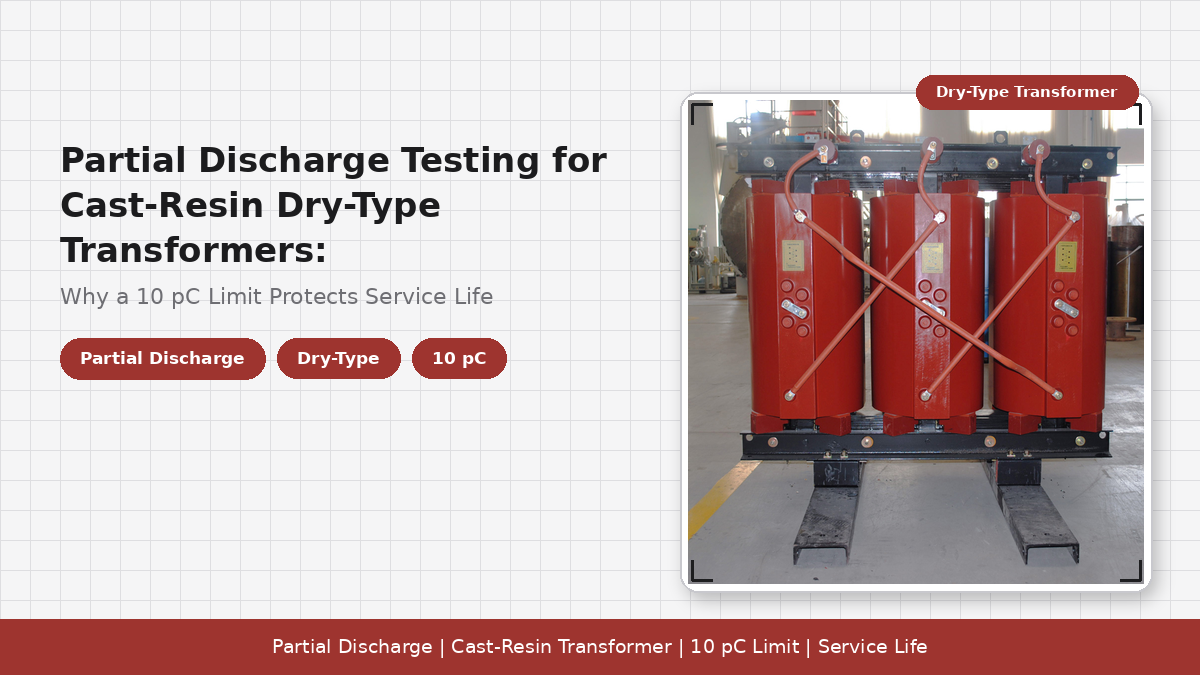
| Partial discharge | Less than 10 pC at rated voltage | Partial discharge is the single most important quality indicator for a cast resin dry-type transformer. Critical for cast resin winding quality; indicates absence of voids that would lead to long-term insulation failure |
Partial discharge is the single most important quality indicator for a cast resin dry-type transformer. High partial discharge (above 10 pC) at rated voltage indicates voids in the epoxy resin casting that will progressively damage the insulation and lead to premature failure. Quality cast resin transformers are tested at 1.5-2x rated voltage during manufacturing to ensure partial discharge remains below the threshold.
Standards Compliance for Rail Transit Transformers
Dry-type transformers for metro installations must comply with multiple overlapping standards, depending on the destination market. The standards hierarchy is:
- IEC 60076-11: The international standard for dry-type transformers. Specifies fire behavior classes F0 and F1, thermal classes, partial discharge limits, and short-circuit withstand requirements. IEC 60076-11 is the global reference and is invoked by metro projects in most markets.
- GB 1094.11: The Chinese national standard for dry-type power transformers, technically equivalent to IEC 60076-11. Required for Chinese domestic metro projects and applied to Chinese export projects in markets that adopt Chinese standards.
- NFPA 130: The North American standard for fixed guideway transit and passenger rail systems. NFPA 130 covers the broader fire safety of transit stations including transformer installations, requiring dry-type construction for indoor installations and addressing fire detection and suppression requirements.
- EN 50588-1: The European standard for small dry-type power transformers, applicable to smaller station-duty units under 315 kVA. Larger units fall under IEC 60076-11.
- IEC 61936-1: The international standard for power installations exceeding 1 kV AC, covering the overall substation design including transformer room layout, clearances, and access. IEC 61936-1 is the reference for room clearances, cable routing, and barrier requirements around indoor transformers.
The typical metro project specification invokes IEC 60076-11 for the transformer itself and NFPA 130 (for North American projects) or local fire codes for the station fire safety strategy. Chinese export projects typically reference both IEC 60076-11 and GB 1094.11 to satisfy both international and destination market requirements.
Installation Considerations
The transformer room layout and installation design have significant impact on transformer performance and longevity in transit service.
Ventilation
Dry-type transformers dissipate heat through the winding surface and rely on air circulation for cooling. Inadequate ventilation is the single most common cause of premature dry-type transformer failure in indoor service. The transformer room must provide adequate ventilation to carry away the dissipated heat:
- AN (natural air) cooling: The room must provide sufficient inlet and outlet openings to allow natural convection airflow through and around the transformer. Typical requirement is 3-5 square meters of net opening for a 1,600 kVA AN transformer.
- AF (forced air) cooling: The transformer fans provide active airflow through the windings, but the room must still provide ventilation to carry away the heat extracted by the fans.
- Ambient temperature: Metro equipment rooms typically operate at 30-40 degrees Celsius ambient. Transformers specified for higher ambient temperatures (45-55 degrees C) cost more but reduce the risk of thermal derating.
Acoustic Considerations
Dry-type transformers produce a characteristic 100 Hz hum at fundamental frequency (for 50 Hz) or 120 Hz (for 60 Hz) operation, with harmonic content from core magnetostriction. The hum level at 1 meter from the transformer is typically 55-65 dB(A) for an SC series unit. For stations adjacent to noise-sensitive areas (residential buildings, hospitals, schools), acoustic treatment of the transformer room may be necessary.
Fire Detection
Even with F1 fire behavior classification, the transformer room should have smoke detection and either automatic fire suppression or fire department coordination. The detection system typically integrates with the station's broader fire alarm system.
Access and Maintenance Clearance
IEC 61936-1 specifies minimum clearances around dry-type transformers for operator safety during switching and maintenance. Typical requirements include 1.0-1.5 meters of front access for tap changer operation and 0.5-1.0 meter of side and rear access for inspection.
Maintenance and Lifecycle
A properly specified and maintained dry-type transformer in metro service achieves 25-30 years of service life. The maintenance program that supports this lifecycle is straightforward but must be performed consistently.
Routine Maintenance Tasks
- Annual thermal imaging: Identify hot spots in connections and windings before they become failures. A 10-15 degree C temperature rise above baseline indicates a developing issue.
- Periodic insulation resistance testing: Megger test of winding insulation to ground at intervals of 2-5 years. Readings above 100 megaohm are normal; below 10 megaohm indicate moisture or insulation degradation.
- Cleaning of ventilation paths: Dust accumulation on winding surfaces and in cooling ducts reduces thermal performance. Annual cleaning is standard.
- Tap changer inspection: If the transformer has an off-load or on-load tap changer, periodic inspection and contact cleaning extends tap changer life.
- Partial discharge trending: For cast resin transformers, periodic partial discharge measurement can identify insulation degradation before failure.
Lifecycle Replacement Strategy
Most metro operators replace transformers on a proactive schedule tied to the asset management plan, typically at 25-30 years of service or when condition assessment indicates elevated failure risk. Planned replacement also allows the new transformer to be specified with current-efficiency windings, reducing transformer losses by 30-50% compared to a 25-year-old unit and delivering measurable energy cost savings over the next asset cycle. Reactive replacement (run to failure) is not appropriate for metro service where a transformer failure causes immediate service disruption and emergency replacement is expensive. The replacement transformer for an emergency replacement costs materially more than a planned replacement because of expedited manufacturing, expedited shipping, and emergency installation labor premium.
Project Reference Categories
The Tianan Overseas project reference list spans several rail transit categories. The most valuable comparison for a new metro buyer is installations in the same destination country and similar climate zone - the same standard applies but the local installation contractor experience and commissioning authority approval process varies significantly across markets. The relevant categories for dry-type transformer applications include:
- Metro stations: Underground, at-grade, and elevated stations on metro lines in Asia, Africa, and South America. Standard 10 kV primary, 400 V secondary, 800-2,500 kVA ratings.
- Light rail and tram stations: Lower-power stations on light rail and tram systems, typically 400-800 kVA per station.
- Commuter rail stations: Higher-power stations on commuter rail systems, sometimes with overhead electrification integration.
- Depots and maintenance facilities: Multi-transformer depot installations with N+1 redundancy, 1,600-5,000 kVA total capacity.
- Tunnel ventilation: Specialized transformer installations for tunnel ventilation fans, often with high IP rating and remote location operation.
The project reference list shows the range of installation types where the SC series has been deployed. For buyers evaluating new metro projects, the reference list is the most efficient way to identify installations in similar climate, load, and configuration conditions.
FAQ
Why do metro stations use dry-type transformers instead of oil-filled?
Dry-type transformers are specified for metro station indoor installations because they eliminate the fire and environmental risks of mineral oil cooling. Dry-type transformers with epoxy resin or cast resin insulation meet IEC 60076-11 Class F1 fire behavior classification and require no oil containment, no fire suppression system dedicated to the transformer, and no oil disposal infrastructure.
What kVA rating does a metro station transformer typically need?
A typical metro station's main dry-type transformer is rated in the 800 kVA to 2,500 kVA range, with 1,000-1,600 kVA being the most common specification for a single-station unit. Larger interchange stations with higher passenger throughput may require 2,500 kVA or dual transformer configuration.
What is the difference between station duty and depot duty transformers?
Station duty transformers power the building services loads of a passenger station. Depot duty transformers power the maintenance and stabling facility loads including vehicle inspection equipment, wheel lathes, washing plants, and lifting jacks. Depot duty ratings are typically 50-200% larger than station duty ratings and frequently use multiple paralleled transformers with N+1 redundancy.
What is the expected service life of a dry-type transformer in transit service?
A properly specified and maintained dry-type transformer in metro service typically achieves 25-30 years of service life, with some installations exceeding 35 years. The life-limiting factors are winding insulation degradation and mechanical vibration from adjacent train operations. Routine maintenance including annual thermal imaging and insulation testing extends service life toward the high end of the range.
What fire safety standards apply to dry-type transformers in transit stations?
The relevant fire safety standards depend on the destination market. IEC 60076-11 specifies dry-type transformer fire behavior classes F0 and F1 for international projects. NFPA 130 covers broader transit station fire safety for North American projects. GB 1094.11 covers dry-type transformer fire safety for Chinese projects. The F1 classification is the typical transit-project requirement.
Closing Note From the Engineering Desk
The dry-type transformer is a 25-30 year asset that quietly delivers station power with minimal intervention. The design decisions made during the specification phase - fire behavior class, kVA rating, voltage class, partial discharge quality, acoustic treatment, ventilation design - determine whether the asset performs reliably for its full design life or generates avoidable fire safety, maintenance, or operational issues over decades of service.
For buyers evaluating the SC series 10 kV dry-type transformer for station duty as part of a metro project specification, or reviewing the broader rail transit industry power solutions portfolio, the framework above should be reviewed alongside the project specifications before placing the order. The transformer specification that matches the project requirements at the design stage delivers the lowest 30-year lifecycle cost and the highest reliability.
For transit project inquiries including station duty rating, depot duty configuration, fire safety class, voltage class, and destination market standards, send your project parameters via the contact form linked from the Tianan Overseas main site. The international sales team responds with a feasibility assessment and project-specific quotation within one business day.