
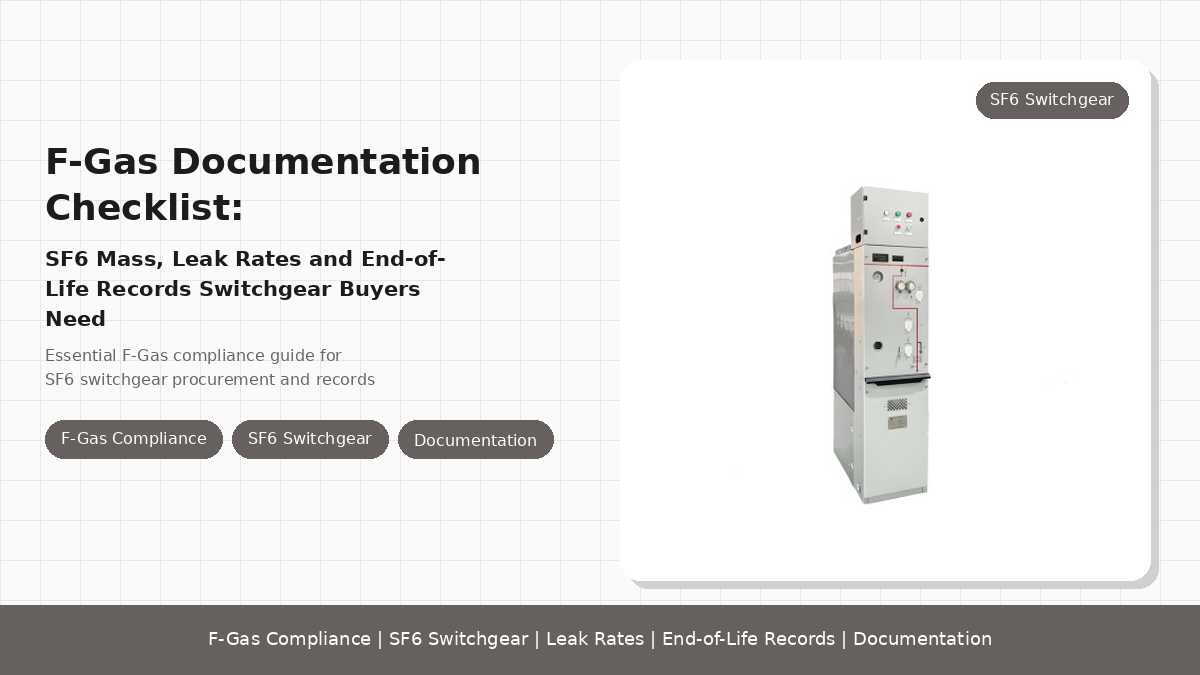

SF6 is the most potent greenhouse gas in commercial use. A single kilogram of sulfur hexafluoride released into the atmosphere has the same warming impact as approximately 23.5 tonnes of carbon dioxide — and it persists in the atmosphere for up to 3,200 years. The EU's F-Gas Regulation (Regulation 517/2014) treats this seriously: it requires every operator of SF6-containing switchgear to maintain detailed records of gas quantities from the moment the equipment is commissioned, to calculate and report annual leak rates, and to ensure the gas is recovered by certified personnel when the equipment reaches end of life. For EU buyers procuring switchgear from non-EU manufacturers, the documentation obligations start before the equipment arrives on site — at the point of purchase.
"The most common compliance gap we see with EU buyers who are new to F-Gas regulated switchgear is arriving on site with the equipment and discovering they have no documentation — no initial charge certificate, no logbook, no factory leak test report. Under EU Regulation 517/2014, the operator is responsible from the moment of commissioning. If the documentation chain starts blank, the buyer is already in non-compliance before the breaker has been energized."
— Mr. Henry, International Sales Manager, Ningbo Tianan Imp. & Exp. Co., Ltd.
1. EU Regulation 517/2014: The F-Gas Framework for Switchgear
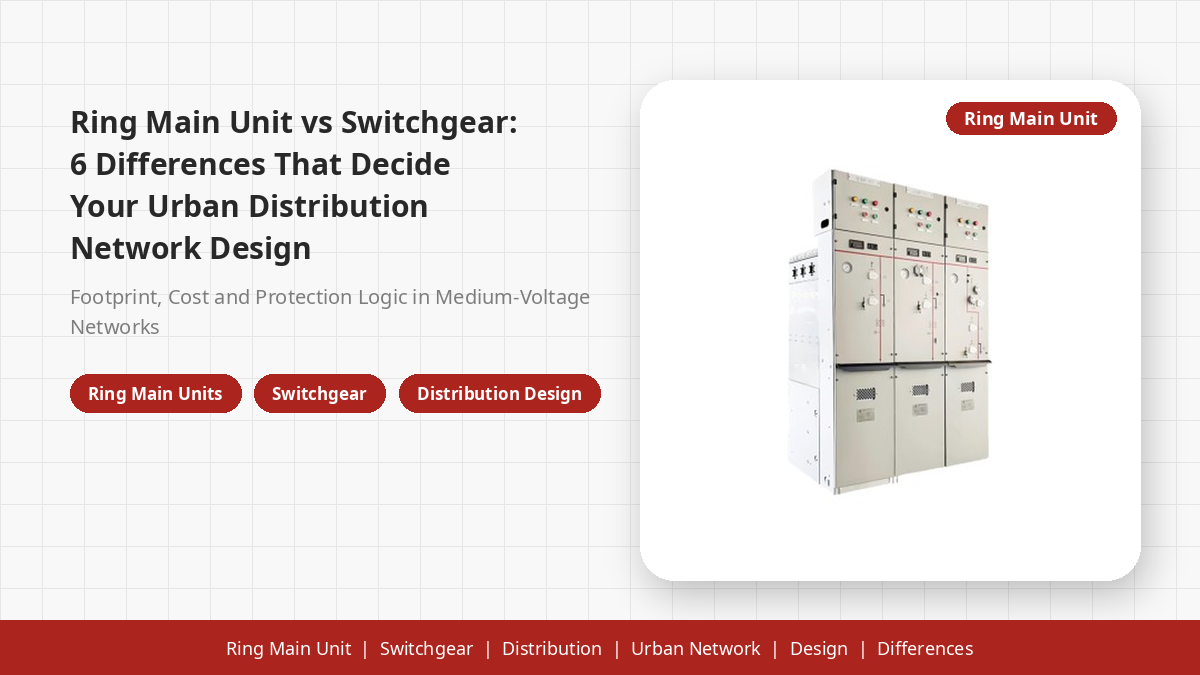
The F-Gas Regulation (EU) No 517/2014 establishes the legal framework for controlling fluorinated greenhouse gas emissions in the EU. Its application to switchgear is direct: any equipment that contains SF6 — whether a 12kV ring main unit, a metal-clad switchgear panel, or a gas-insulated busbar — falls squarely within the scope of the regulation. The operator of that equipment is legally responsible for compliance, and that responsibility is documented, reported, and enforceable.
The regulation's obligations for switchgear operators are concentrated in four areas: gas charge documentation, leak detection and reporting, equipment transfer procedures, and end-of-life recovery. Each of these generates a paper trail that must be maintained for at least five years after the equipment is permanently removed from service — and that paper trail must be complete enough that a regulatory authority could reconstruct the gas history of each switchgear panel from commissioning to destruction.
2. SF6 Gas Mass Recording: The Foundation of the Compliance Record
The equipment logbook is the core document in F-Gas compliance for switchgear. It records every gram of SF6 that enters and leaves the equipment throughout its operational life, creating an auditable chain of custody from the factory charge to the final destruction certificate.
2.1 What Must Be Recorded at Commissioning
When SF6 switchgear is commissioned — the moment the equipment is first energized and placed into service — the operator must make the first entry in the equipment logbook. This entry must record the factory charge quantity (in kilograms of SF6 and the corresponding CO2 equivalent), the date of commissioning, the operator's name and contact details, the site location, and the name of the undertaking that performed the commissioning. The factory charge quantity must be taken from the manufacturer's charge certificate, which should accompany the equipment at delivery. CIGRE technical standards provide guidance on SF6 handling procedures and documentation practices that manufacturers and operators use as reference for commissioning logbook entries.
2.2 The Equipment Logbook: Required Fields and Retention Period
The F-Gas Regulation requires that the following information be recorded in the equipment logbook for each operation involving the SF6 charge:
- Date of the operation (charging, top-up, recovery, destruction)
- Identity of the undertaking performing the operation (company name, certification number)
- Name and signature of the responsible person
- Quantity of SF6 charged (kg)
- Quantity of SF6 recovered (kg) — for maintenance, transfer, or end-of-life
- Quantity of SF6 added to make up losses (kg)
- Quantity of SF6 destroyed or reclaimed (kg) — for end-of-life only
- Total SF6 charge remaining in the equipment after the operation (kg)
Records must be retained for a minimum of five years after the equipment is permanently removed from service. In practice, most operators maintain equipment logbooks for the full operational life of the switchgear — typically 25–40 years — and archive them for at least five years after final decommissioning. Digital logbook systems, where records are stored in a tamper-evident format and backed up, are increasingly used by utilities and industrial facility operators to meet this requirement.
Before your SF6 switchgear arrives on site, the manufacturer should provide: (1) an SF6 charge certificate stating the factory charge mass in kilograms and the CO2 equivalent; (2) a factory leak test report confirming the equipment was pressure-tested and leak-checked before dispatch; (3) a blank or semi-completed equipment logbook with the commissioning entry template; and (4) a copy of the manufacturer's Article 8 declaration — a statement that the SF6 will be recovered by certified personnel at end-of-life. Request this documentation at the RFQ stage, not after delivery.
3. Annual Leak Rate: Calculation, Thresholds, and Reporting
The leak rate is the metric that regulatory authorities use to assess whether an operator is maintaining their switchgear adequately. A high leak rate signals poor equipment condition or handling practices, and triggers mandatory reporting obligations. Calculating it correctly — and documenting the calculation — is one of the most important ongoing compliance tasks for SF6 switchgear operators.
3.1 How to Calculate the Annual Leak Rate
The annual leak rate is calculated as follows:
Leak rate (%) = (Quantity of SF6 added during the year ÷ Total SF6 charge in equipment) × 100
For example, if a switchgear panel contains 10kg of SF6, and 0.3kg was added during the year to make up losses, the annual leak rate is 3%. This exceeds the 2% reporting threshold and triggers the obligation to report to the competent authority in the member state where the equipment is operated.
The total SF6 charge used in the denominator is the original factory charge quantity — not the current charge, which would change as leaks occur and is precisely what the calculation is designed to measure. Using the factory charge as the denominator ensures that the leak rate calculation is consistent across the equipment's life and comparable across different installations.
3.2 Leak Rate Thresholds and Mandatory Reporting
The F-Gas Regulation sets the following leak rate thresholds and reporting requirements for switchgear:
| SF6 Charge (CO2 eq.) | SF6 Mass (approx.) | Leak Check Frequency | Reporting Threshold |
|---|---|---|---|
| < 500 tonnes CO2 eq. | < ~21.3 kg | Every 12 months | 10% per year |
| 500–5,000 tonnes CO2 eq. | ~21.3–213 kg | Every 6 months | 2% per year |
| > 5,000 tonnes CO2 eq. | > ~213 kg | Every 3 months | 2% per year |
When the leak rate exceeds the reporting threshold, the operator must report to the competent authority in the member state within 30 days of discovering the excess, explain the reasons for the leak, and describe the corrective measures taken or planned. Persistent failure to report or address high leak rates can result in penalties imposed by the national competent authority. EPA regulations in the United States impose similar but less stringent leak rate requirements under the Clean Air Act for SF6 use in electrical equipment.
3.3 Leak Detection Requirements
For switchgear with an SF6 charge above 500 tonnes CO2 equivalent, the F-Gas Regulation requires leak checks to be performed by certified personnel at intervals of no more than six months (and every three months above 5,000 tonnes CO2 equivalent). Leak detection methods include:
- Electronic leak detectors: Positive pressure detection instruments that sense SF6 leakage from pressurized compartments. Suitable for routine operational leak checking.
- Sniffer probe detection: A precision instrument with a sampling probe that detects SF6 concentrations in the surrounding air. Can locate the specific leak point within the switchgear enclosure.
- Static and empty chamber detection: For switchgear compartments that can be taken out of service, a sealed chamber with a detector can identify very small leaks that may not be detectable by sniffer probe in an open environment.
TUV and UL certify leak detection equipment and personnel for F-Gas compliance applications. Certified leak detection service providers are listed by national competent authorities in each EU member state.
4. Equipment Transfer Documentation
When SF6 switchgear changes operator — whether through sale, lease, or transfer to a different entity — the F-Gas documentation must transfer with it. The incoming operator becomes legally responsible for the equipment's F-Gas compliance from the date of transfer, and they cannot assume that responsibility without the documentation to establish the equipment's gas history.
Under Article 13 of the F-Gas Regulation, the transferor must provide the transferee with a transfer certificate that documents: the current SF6 charge quantity (from the most recent logbook entry), the cumulative additions and recoveries since commissioning, and the calculated leak rate to date. The transferee must retain this transfer certificate as the baseline for their own logbook entries going forward.
For EU buyers purchasing switchgear from a non-EU manufacturer — or from a distributor that has imported the equipment — the transfer certificate is typically not available at the point of first sale, because the first EU operator is the first entity in the EU supply chain. In this case, the buyer's primary documentation is the factory charge certificate and factory leak test report provided by the manufacturer. These documents serve as the commissioning logbook entry and establish the baseline for all subsequent calculations.
5. End-of-Life SF6 Recovery and Destruction
When SF6 switchgear reaches the end of its operational life, the SF6 gas must be recovered and either destroyed using approved technology or reclaimed for reuse. This is not optional. Venting SF6 to the atmosphere is a violation of the F-Gas Regulation and can result in significant penalties. The operator is responsible for arranging the end-of-life recovery and retaining the documentation.
5.1 Who Can Perform SF6 Recovery
SF6 recovery from switchgear must be performed by certified personnel holding a company-level F-Gas certificate. In the EU, this certification is typically issued by national competent authorities or authorized certification bodies and covers the handling of F-gases in electrical equipment applications. The certification covers gas recovery procedures, the use of approved recovery equipment, the completion of F-Gas reporting forms, and the completion of destruction or reclamation certificates. CAPIEL (the European Committee of Manufacturers of Electrical Switchgear and Controlgear) coordinates industry standards and training for F-Gas certified personnel in the electrical equipment sector.
5.2 Destruction vs. Reclamation
Recovered SF6 can either be destroyed using approved destruction technology (incineration, plasma decomposition, or other EU-approved methods) or reclaimed — processed to remove impurities and reuse it in new equipment. Reclamation is preferred from an environmental standpoint because it avoids the energy consumption and residual emissions associated with SF6 production. However, reclaimed SF6 must meet purity specifications defined in the F-Gas Regulation and industry standards before it can be recharged into equipment. Destruction certificates and reclamation certificates must be retained by the operator as part of the permanent equipment record.
6. The F-Gas Compliance Documentation Pack: What to Request from Your Supplier
For EU buyers procuring SF6 switchgear from non-EU manufacturers, the most important procurement step is often the one that gets skipped: requesting the F-Gas documentation pack before the equipment is dispatched from the factory. Without these documents, the operator begins their compliance journey in deficit.
The F-Gas compliance documentation pack that buyers should request from their switchgear supplier includes:
- SF6 charge certificate: Issued by the manufacturer, stating the factory charge mass in kilograms, the gas type and purity, the CO2 equivalent, and the equipment serial number(s) to which it relates.
- Factory leak test report: Confirming that the equipment was pressure-tested and leak-checked at the manufacturing facility before dispatch. Should reference the test method used and the acceptance criteria.
- Equipment logbook: A blank or semi-completed logbook template with the commissioning entry pre-filled using the charge certificate data. The logbook should follow the format required by the relevant EU member state's competent authority.
- Article 8 declaration: The manufacturer's statement that they are aware of their obligations under Article 8 of the F-Gas Regulation regarding end-of-life recovery, and that they will arrange or facilitate the recovery of SF6 from the equipment when it reaches end of life.
- Transfer certificate template: For use when the equipment changes operator — completed by the first operator at the point of any subsequent transfer.
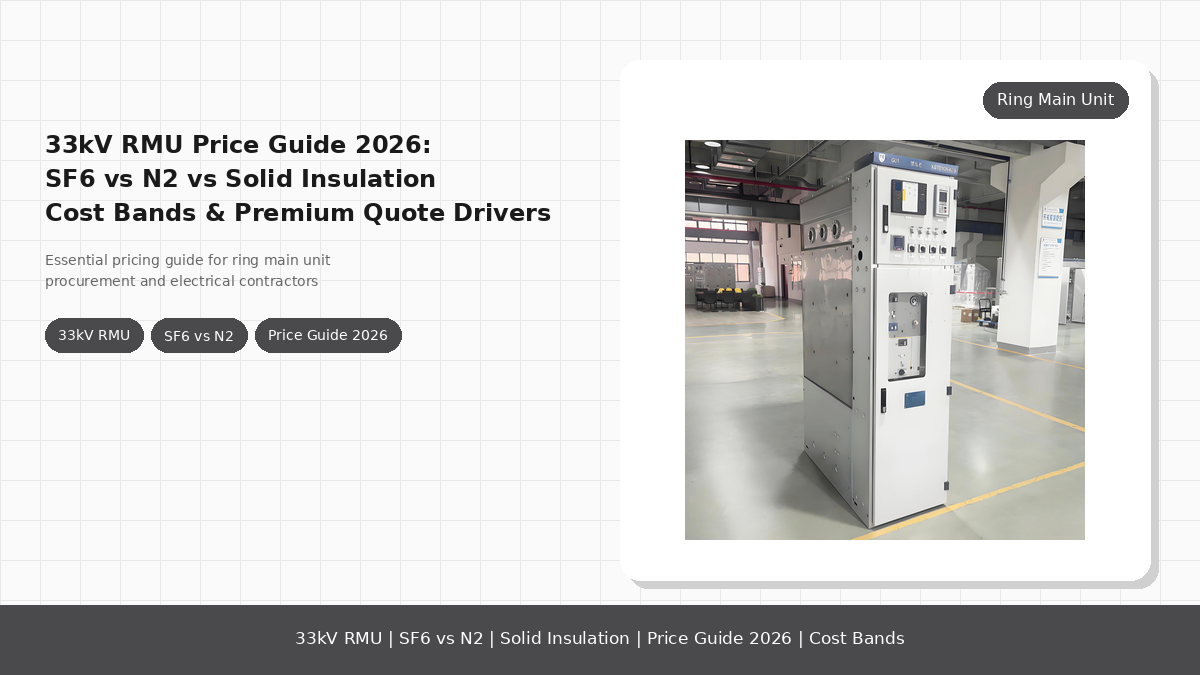
Tianan Overseas's environmentally friendly switchgear range includes both SF6-containing equipment with full F-Gas documentation packs and SF6-free N2 gas insulation switchgear (such as the XGTD8-12) that eliminates F-Gas compliance obligations from the operator's side. EU buyers seeking to simplify their compliance burden should evaluate SF6-free switchgear alternatives as part of their procurement specification. Request Tianan Overseas's F-Gas compliance document pack or discuss SF6-free switchgear options with the Tianan Overseas engineering team.
7. FAQ
What is EU Regulation 517/2014 (F-Gas Regulation) and does it apply to switchgear buyers?
EU Regulation 517/2014 — the F-Gas Regulation — controls emissions of fluorinated greenhouse gases including SF6, which has a global warming potential of 23,500 times that of CO2. For switchgear buyers in the EU, the relevant obligations arise when purchasing, installing, operating, maintaining, or disposing of SF6 gas-insulated switchgear: the buyer becomes the equipment operator and bears responsibility for leak detection, record-keeping, and reporting. The regulation requires operators to maintain equipment records, calculate annual leak rates, report when leak rates exceed thresholds, and ensure SF6 is recovered by certified personnel at equipment end-of-life.
What SF6 gas mass records must be kept for switchgear under the F-Gas Regulation?
Under Article 9 of the F-Gas Regulation, operators of equipment containing SF6 must maintain records of the quantity of gas charged at commissioning, the quantity recovered during maintenance or servicing, the quantity added to make up losses, and the quantity destroyed at end-of-life. These records must be kept in the equipment logbook and retained for at least five years after the equipment is permanently removed from service. Records must include the date, the identity of the undertaking performing the operation, the quantity charged, recovered, added, or destroyed, and the name and signature of the responsible person. Buyers should request the F-Gas documentation pack including the initial charge record and logbook template from the supplier before delivery.
How is the annual leak rate for SF6 switchgear calculated and when must it be reported?
The annual leak rate is calculated as: (quantity of SF6 added during the year divided by the factory SF6 charge quantity) multiplied by 100. Under Article 19 of the F-Gas Regulation, operators must report to the competent authority if the leak rate exceeds 2% per year for equipment with a charge of 500 tonnes CO2 equivalent or more, or 10% per year for equipment with a charge below 500 tonnes CO2 equivalent. For switchgear above 500 tonnes CO2 equivalent, leak checks must be performed at least every six months by certified personnel; above 5,000 tonnes CO2 equivalent, at least every three months.
What happens to F-Gas documentation when switchgear is transferred between operators?
When SF6 switchgear is sold or transferred to a new operator, the F-Gas documentation — including the equipment logbook with all entries — must be transferred with the equipment. The transferor must provide the new operator with a transfer certificate documenting the current SF6 charge quantity, any additions or recoveries since commissioning, and the leak rate history. The new operator becomes responsible for F-Gas compliance from the date of transfer. EU buyers purchasing from non-EU manufacturers should ensure the supplier provides the initial F-Gas charge documentation at the point of transfer — without this, the EU buyer cannot establish a compliant baseline.
What are the end-of-life requirements for SF6 switchgear?
Under Article 8 of the F-Gas Regulation, SF6 must be recovered by certified personnel and either destroyed using approved technology or reclaimed for reuse at the end of life of the switchgear. The recovery and destruction must be documented in the equipment logbook, and the undertaking performing the recovery must provide a destruction or reclamation certificate. The equipment operator is responsible for arranging end-of-life recovery and bearing the cost. SF6 cannot be vented to the atmosphere under any circumstances. Operators should factor end-of-life recovery costs into the total cost of ownership when specifying or procuring SF6 switchgear.
How can switchgear buyers prepare an F-Gas compliance documentation pack for their procurement?
An F-Gas compliance documentation pack should contain: the initial SF6 charge certificate from the manufacturer (factory charge mass in kg and CO2 equivalent); the equipment logbook with pre-filled commissioning entry; a factory leak test report from the manufacturer's factory acceptance test; a copy of the manufacturer's Article 8 declaration for end-of-life handling; and a transfer certificate template for use when the equipment changes operator. When sourcing from a non-EU manufacturer, buyers should request the compliance pack at the RFQ stage so missing documentation can be resolved before the equipment leaves the factory.