

0102030405
GCS vs GCK vs GGD vs MNS: China's Four Low-Voltage Switchgear Types Compared for Export Buyers
2026-09-16
Every month, an export buyer in Africa or the Middle East or Southeast Asia emails me the same question: "I have a quotation sub for a GCS vs GCK vs GGD vs MNS switchgear project — which frame should I choose?" The honest answer is that the four frame types are not interchangeable, and the choice between them depends on the operation profile of the project, the qualification baseline the buyer is committing to, and the budget the project has to work within. A GCS panel for a utility substation and a GGD panel for a small industrial workshop are the right answer in each case, but the same GCS in the workshop and the same GGD in the substation would each be the wrong answer.
After fifteen years of exporting power equipment — switchgear, transformers, and the broader substation line — to utility and infrastructure projects across Asia, Africa, the Middle East, and South America, I have watched the same handful of specification mistakes repeat across every region. The buyer who specs a fixed-mount GGD for a utility substation discovers within two years that every maintenance operation requires a busbar outage. The buyer who specs a withdrawable MNS for a small commercial building pays twice what the project requires and ends up with a panel that nobody fully uses. This article walks through the four frame types, the operation profiles each one is optimized for, and the procurement verification that ensures the panel actually meets the IEC 61439 standard the buyer is committing to. The reference configuration is the Tianan low-voltage switchgear category and the GCS LV withdrawable switchgear used as the anchor.
TL;DR — What You'll Learn
- GCS and GCK are withdrawable industrial MCC designs; MNS is a modular utility-grade design; GGD is a fixed-mount cost-sensitive design.
- Operation profile dictates the choice, not unit price — frequent operation cycles favor withdrawable designs.
- IEC 61439 is the international standard that applies to all four, and a serious export supplier should provide the type-test report.
- For utility substations and critical-load applications, MNS or GCS withdrawable design is the right answer.
Core answer. GCS and GCK are withdrawable designs optimized for industrial motor control centers with frequent operation. MNS is a modular design with a wider drawer module range optimized for utility distribution and large infrastructure switchgear. GGD is a fixed-mount design for cost-sensitive applications with low operation frequency. Because the right frame is the one that matches the operation profile, not the one with the lowest unit price, the procurement evaluation should start with the operation profile and end with the frame type.
What Is a Low-Voltage Switchgear Frame Type, and Why Are There Four?
A low-voltage switchgear frame is the structural envelope that organizes the busbars, the circuit breakers, the protection relays, the cable terminations, and the operator-access controls into a defined form factor. The frame determines the dimensions, the busbar arrangement, the drawer or compartment layout, the cable entry direction, and the operator-interlock behavior. Two switchgear panels from two different frame types are not interchangeable in the field — they require different foundation dimensions, different cable terminations, and different operator training.
China developed four national low-voltage switchgear frame types over the past three decades, each optimized for a slightly different combination of operation profile and cost target. The four frame types are not in competition with each other; they cover different points in the cost-versus-capability tradeoff curve. A serious export buyer should understand what each frame type does well and what each frame type is the wrong answer for.
The international standard that governs low-voltage switchgear is IEC 61439, which the International Electrotechnical Commission (IEC) publishes through its technical committee structure. The relevant parts for these four frame types are IEC 61439-1 (general rules) and IEC 61439-2 (specific requirements for power switchgear and controlgear assemblies). A serious Chinese switchgear supplier should have type-test reports for each frame type against the relevant part of IEC 61439.
Why China has four national frame types. The four frame types cover the cost-versus-capability space in a way no single frame can. GGD addresses cost-sensitive applications; GCS and GCK address industrial MCC applications; MNS addresses utility-grade applications. Because the four frame types cover different points in the tradeoff curve, they coexist as a national framework, not as competing standards.
What Is GCS Low-Voltage Switchgear?
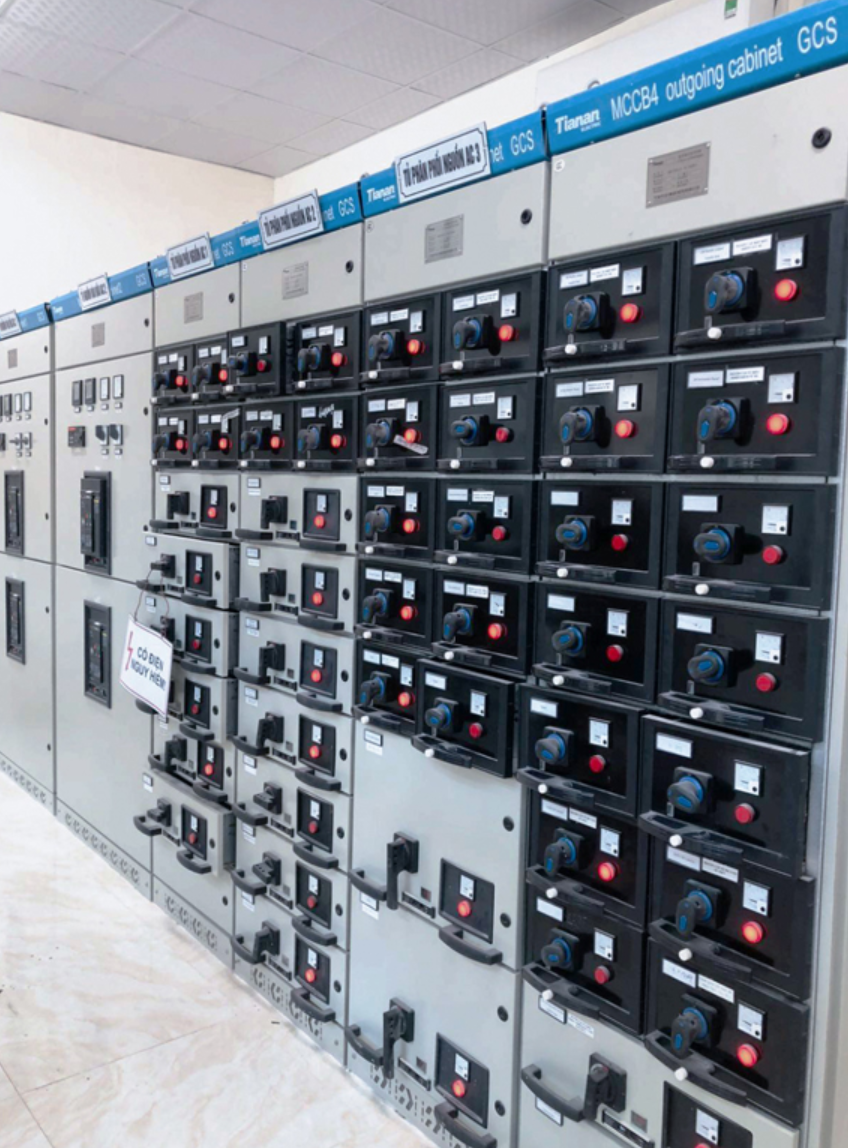
GCS is a withdrawable-frame design optimized for industrial motor control centers. The frame uses a 9-modular-per-drawer structure where each drawer occupies 162 mm of vertical height (9 modules × 18 mm per module), and the drawers can be pulled out of the panel for maintenance or functional-unit replacement without de-energizing the busbar.
GCS was developed in the 1990s as a successor to the older GCK and fixed-mount designs, and it has become the most commonly specified Chinese withdrawable frame for industrial plant MCC applications. The structural design uses a C-profile steel frame with bolted construction, which makes the panel easy to assemble, easy to modify on-site, and easy to ship in knocked-down form for export projects that require container-friendly packaging.
For export applications, GCS is well-suited to industrial plant projects where the operation profile includes frequent motor starting and stopping, where the operator needs to swap functional units without de-energizing the busbar, and where the budget does not justify the higher cost of MNS. The reference product for this article is the Tianan GCS LV withdrawable type switchgear, which is designed and tested against IEC 61439 for export applications.
The GCS structural choice that matters most for export. The C-profile bolted frame. Compared to the welded-frame designs of older switchgear, the bolted C-profile allows the panel to be knocked down for container shipping, which is the right answer for export projects where the destination port does not have ready access to the project site. Because the bolted C-profile reduces shipping volume by roughly 30 percent compared to welded construction, the export buyer gets a meaningful logistics cost reduction without any loss of structural integrity.
What Is GCK Low-Voltage Switchgear?
GCK is also a withdrawable-frame design but with an earlier-generation internal structure. GCK was the dominant Chinese industrial MCC frame before GCS was introduced, and it remains in active production for projects that specify the older frame design.
The GCK structural design uses a different busbar arrangement than GCS and a different drawer module system. The compatibility result is that GCK drawers are not interchangeable with GCS drawers, which is an important consideration for projects that have an existing GCK install base and want to standardize on a single frame type across the plant.
For new export projects in 2026, the choice between GCK and GCS usually comes down to two factors: the buyer's preference for the older or newer structural design, and the supplier's qualification status. A supplier that has invested in GCS production tooling and IEC 61439 testing for GCS will typically recommend GCS over GCK for new projects. A supplier that has invested in GCK production tooling will typically recommend GCK.
The decision that determines whether to choose GCK over GCS. Whether the buyer has an existing GCK install base. Because GCK and GCS drawers are not interchangeable, a plant with an existing GCK installation is better served by continuing with GCK than by switching to GCS, even if GCS is the newer frame design.
What About the Operational Differences?
GCK and GCS are both withdrawable designs with similar operator-experience profiles. The drawer pull-out mechanism is similar, the operator-interlock behavior is similar, and the busbar arrangement is similar enough that an operator trained on one frame can transition to the other with minimal retraining. The operational differences are typically in the details of the drawer engagement and the position-indicator behavior, which is why a thorough operator training cycle is still recommended when transitioning between frame types.
What Is MNS Low-Voltage Switchgear?
MNS is a modular-frame design with a wider drawer module range than GCS or GCK. The MNS structural design uses a 1-modular-to-72 mm unit (1 × 72 mm, 2 × 72 mm, 3 × 72 mm drawers), which gives the operator a broader range of drawer sizes to fit different functional units and a cleaner compartmentalization between adjacent drawers.
MNS is the preferred Chinese frame type for utility-grade applications, for large infrastructure projects, and for export projects in markets where the MNS frame is the local standard. The MNS design is also more expensive than GCS at the same current rating, because the modular structure uses more busbar material and more complex drawer mechanisms. The cost premium is justified for applications where the operator-experience advantages of the modular design matter.
For export applications, MNS is the right answer for:
- Utility substations where the operator needs to maintain and replace functional units without busbar outages.
- Large industrial switchgear where the drawer module range matters for the application mix.
- Data centers and hospitals where critical-load applications demand the operational advantages of a withdrawable modular design.
- Markets where MNS is the local standard — particularly in the Middle East and parts of Africa where MNS is the established frame design.
For the broader regulatory framework that applies to the destination-market installation, the most authoritative U.S. reference is the UL safety certification framework and the broader NFPA National Electrical Code framework for U.S. installations. For the EU equivalent, the European Committee for Electrotechnical Standardization (CENELEC) is the relevant standards body, and the parallel CENELEC standards portfolio is the right reference for European-market compliance.
Why MNS costs more than GCS. The modular busbar arrangement and the wider drawer module range use more copper and more complex drawer mechanisms. Because the cost premium reflects operational capability, not luxury, the MNS price premium is justified for any application where the operator-experience advantages actually get used.
What Is GGD Low-Voltage Switchgear?
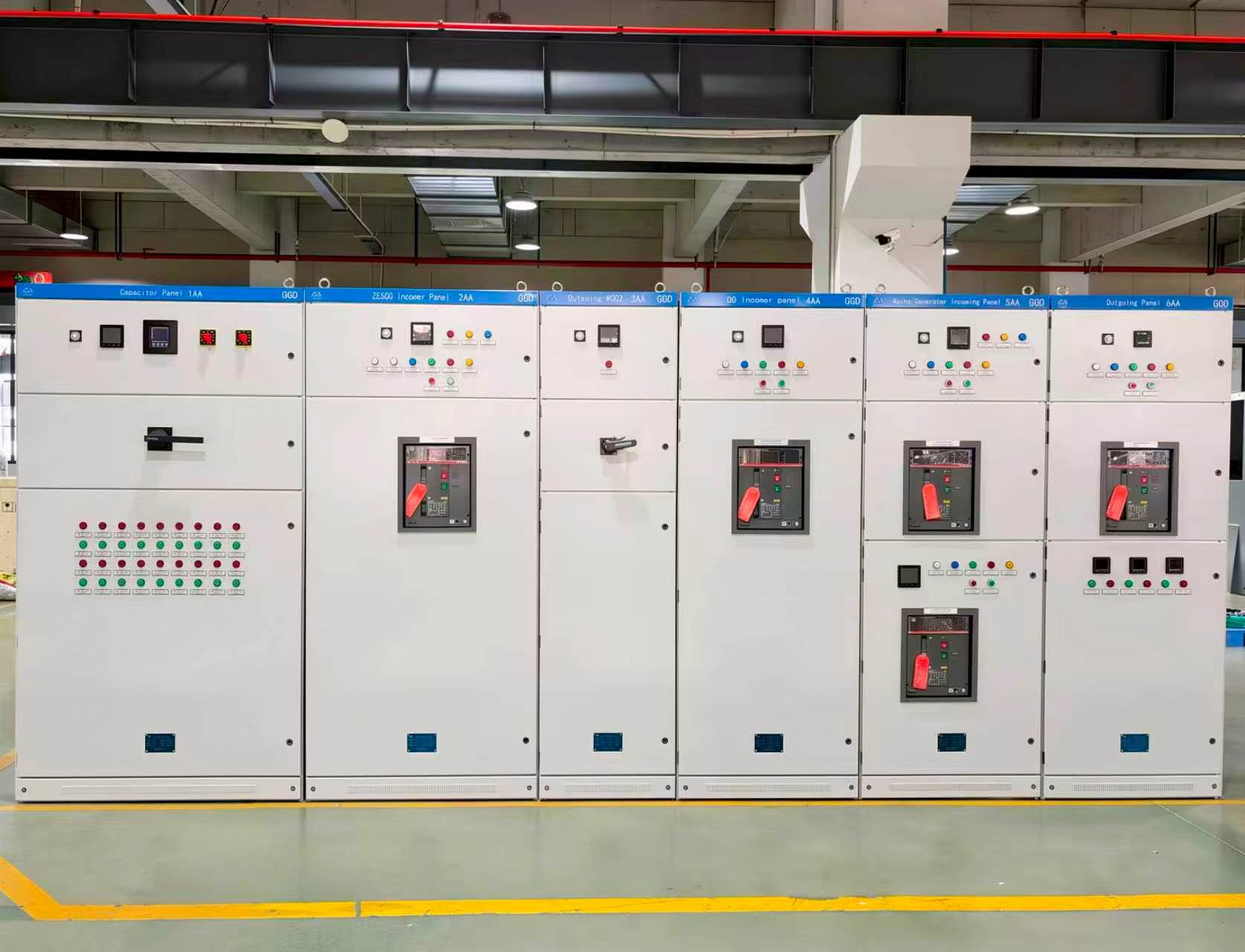
GGD is a fixed-mount design for cost-sensitive applications with low operation frequency. The frame uses a simple compartmentalized structure where each compartment holds a fixed-mounteD Circuit Breaker or functional unit, and the operator accesses each compartment via a hinged panel for maintenance.
GGD is widely deployed in:
- Agricultural distribution networks. Where the panel is configured once and rarely modified.
- Light commercial buildings. Where the panel serves a small number of fixed loads.
- Small industrial workshops. Where the operation frequency is low and the operator does not need to swap functional units.
- Substation auxiliary distribution.Where GGD serves as the lighting and small-Power Distribution panel inside a larger substation built around MNS or GCS withdrawable panels.
The cost advantage of GGD comes from the simpler structural design — no drawer mechanisms, no position interlocks, no modular busbar. The operational disadvantage is that every maintenance operation requires a busbar outage, which is why GGD is the right answer for fixed-configuration applications and the wrong answer for applications that need frequent functional-unit swapping.
For the broader U.S. market framework that includes GGD-equivalent fixed-mount designs, the National Electrical Manufacturers Association (NEMA) is the relevant standards body for North American switchgear. For the parallel international framework, the IEC standards are the right reference.
Why GGD is not obsolete. It is the right answer for cost-sensitive applications with low operation frequency, and no other frame type serves that market as well. Because GGD is the lower-cost option for the right application, it is a permanent member of the four-frame national lineup, not a legacy frame waiting to be replaced.
| Frame Type | Mounting | Module Structure | Best For | Cost Tier |
|---|---|---|---|---|
| GCS | Withdrawable | 9 × 18 mm modules per drawer | Industrial MCC, frequent operation | Mid |
| GCK | Withdrawable | Earlier-generation drawer module | Legacy GCK install base | Mid |
| GGD | Fixed mount | Compartmentalized fixed units | Cost-sensitive, low operation frequency | Low |
| MNS | Withdrawable modular | 1–3 × 72 mm drawer units | Utility substations, critical load, large infrastructure | Mid-to-high |
Which Frame Should an Export Buyer Choose?
The right answer depends on the operation profile of the project, the qualification baseline the buyer is committing to, and the budget the project has to work within. Three decision trees cover most of the export cases.
- Choose GGD when the operation profile is low-frequency, the panel configuration is fixed, the application is non-critical, and the budget is the dominant constraint. GGD is the right answer for agricultural distribution, light commercial buildings, small workshops, and substation auxiliary panels.
- Choose GCS or GCK when the operation profile is moderate to high frequency, the operator needs to swap functional units without busbar outages, and the project is industrial plant or motor control. GCS is the newer frame design; GCK is the right answer if the project has an existing GCK install base.
- Choose MNS when the application is utility-grade, the project is a critical-load application (data center, hospital), the destination market prefers MNS, or the project has a complex mix of drawer sizes. MNS is the right answer when the operational advantages justify the cost premium.
For the broader regulatory and standards framework that the export project must satisfy, the most authoritative international reference is the IEC and the CENELEC framework for European installations. For the trade and export compliance context, the U.S. Commercial Service country commercial guides are the most authoritative U.S. public reference on destination-market compliance requirements.
The decision tree that catches the most buyers. "What happens when the operator needs to replace a feeder breaker?" If the answer involves a busbar outage, the project needs a withdrawable design. Because a busbar outage is a much bigger operational event than a drawer swap, the answer to this question usually determines the frame type, not the procurement cost.
What About the IEC 61439 Verification?
Whichever frame type is chosen, the export buyer should verify that the supplier has type-tested the panel against IEC 61439-1 and IEC 61439-2 at an accredited lab. The verification has three steps:
- Ask for the type-test report. The supplier should produce a third-party lab test report from an ILAC-accredited lab, typically one of the major Chinese testing institutes (CTI, CGC) or an international lab (CESI, KEMA, TUV).
- Verify the lab's accreditation. The right answer is an ILAC-accredited lab with a current ISO/IEC 17025 accreditation for the relevant IEC 61439 test methods.
- Verify the type-test coverage matches your project. The type-test report should cover the specific frame size, current rating, short-circuit withstand rating, and busbar arrangement of the panel you are buying — not a different frame that the supplier happened to test.
For the broader quality and compliance framework that the supplier's manufacturing process should satisfy, the most authoritative U.S. public reference is the NIST Manufacturing Innovation program, and the most authoritative international reference is the IEEE standards portfolio. For the trade context that affects cross-border shipment, the Trade.gov industries portal maintains current sector guidance for power equipment exports.
The IEC 61439 report that catches the most weak suppliers. A report for a different current rating than the panel you are buying. Because a 4000 A type-test report does not cover a 6300 A panel, the type-test report has to match the exact frame, current, and short-circuit rating of the project.
What Mistakes Do Export Buyers Most Often Make?
Three mistakes repeatedly catch even experienced procurement teams off guard when they are specifying a Chinese low-voltage switchgear for an export project. None of them are exotic; they are the questions that don't get asked until the container is already at the destination port.
- Specifying the frame type before the operation profile. The procurement team picks GCS or MNS because the supplier's brochure is the most polished, not because the operation profile justifies the choice. The right sequence is operation profile first, frame type second.
- Skipping the IEC 61439 type-test verification. The buyer accepts the supplier's IEC 61439 claim without asking for the actual type-test report and without verifying that the lab is accredited and that the report covers the panel being bought.
- Not budgeting for the auxiliary systems. The buyer budgets for the panel itself but not for the busbar, the cable terminations, the protection relays, or the commissioning. A complete project budget includes all four.
The decision, in one sentence. Choose the frame type that matches the operation profile, verify the IEC 61439 type-test report matches the panel being bought, and budget for the panel plus its auxiliary systems plus its commissioning. Because the right frame at the right price with the right qualification is what produces a substation that runs for twenty years, the procurement evaluation should be the most rigorous step in the project, not the most rushed.
Talk to Tianan About Your LV Switchgear Specification
Share your project scope, current rating, short-circuit withstand requirement, and destination market, and Tianan will specify the right LV frame — GCS, GCK, GGD, or MNS — with the IEC 61439 type-test report and the destination-market certification. Browse our low-voltage switchgear category or our GCS LV withdrawable switchgear.
Contact Tianan OverseasFrequently Asked Questions
What is the difference between GCS, GCK, GGD, and MNS low-voltage switchgear?
GCS, GCK, GGD, and MNS are four Chinese low-voltage switchgear frame types that share similar dimensions and functional categories but differ in structural design, withdrawable mechanism, and the typical application they are optimized for. GCS and GCK are withdrawable-frame designs optimized for industrial plants with frequent operation cycles. MNS is a modular multi-frame design with a wider drawer module range, often preferred for utility substations and large infrastructure projects. GGD is a fixed-mount design for cost-sensitive applications with low operation frequency. The right choice depends on the operation profile, the application environment, and the procurement budget.
Which Chinese low-voltage switchgear frame is best for export to Africa or the Middle East?
For export to Africa or the Middle East, GCS and MNS are the two most commonly specified frame types because they meet the IEC 61439 low-voltage switchgear standard and because their withdrawable design supports the operation patterns of utility substations in those markets. MNS is the more common choice for utility-grade projects, while GCS is the more common choice for industrial plant MCC applications. Both frame types can be tested against IEC 61439 at the supplier's lab, and a serious export supplier should provide the IEC 61439 type-test report on request.
How does GCS low-voltage switchgear differ from MNS?
GCS and MNS are both withdrawable-frame designs but differ in their internal structural and. and module compatibility. GCS typically uses a 9-modular-per-drawer structure (9 × 18 mm = 162 mm drawer height unit) and is optimized for industrial motor control centers. MNS uses a 1-modular-to-72 mm unit structure (1 × 72 mm, 2 × 72 mm, 3 × 72 mm drawers) and offers a wider range of drawer sizes for utility distribution and large industrial switchgear. The right choice depends on whether the application is motor control (GCS) or power distribution (MNS).
Is GGD low-voltage switchgear still relevant in 2026?
GGD remains the right answer for cost-sensitive applications with low operation frequency and where the operator does not need to swap functional units under power. It is widely deployed in agricultural distribution, in light commercial buildings, in small industrial workshops, and as the lighting and small-power distribution panel in larger substations. For applications where the functional units are configured once and rarely changed, GGD's fixed-mount design is more economical than a withdrawable-frame design. The right answer is to specify GGD where the operation profile justifies it, not as a default.
What IEC standard applies to all four of these switchgear types?
IEC 61439 is the international standard that applies to low-voltage switchgear and controlgear assemblies, including all four of the Chinese frame types. IEC 61439-1 covers the general rules, IEC 61439-2 covers the specific requirements for power switchgear and controlgear assemblies, and IEC 61439-3 covers distribution boards. A supplier that has tested their GCS, GCK, GGD, or MNS product against IEC 61439-1 and IEC 61439-2 at an accredited lab should be able to provide the type-test report on request.
How should an export buyer verify a Chinese switchgear supplier's IEC 61439 compliance?
The verification has three steps. First, ask for the supplier's IEC 61439-1 and IEC 61439-2 type-test report, which is a third-party lab test report from an accredited lab. Second, verify the lab that issued the report — the right answer is an ILAC-accredited lab, typically one of the major Chinese testing institutes or an international lab such as CESI, KEMA, or TUV. Third, verify that the type-test report matches the specific frame size and current rating you are buying, not a different frame that the supplier happened to test.
What is the typical price difference between GCS and MNS switchgear?
MNS typically costs more than GCS at the same current rating because the MNS modular structure uses more busbar material and more complex drawer mechanisms. The cost difference varies with the project specification, the current rating, and the supplier, but MNS is generally in the moderate-to-high cost tier and GCS is in the moderate cost tier. The right comparison is total project cost including the operational advantages of the withdrawable design, not just the unit cost of the panel.
Which frame type is best for a data center or hospital critical load application?
For data center and hospital critical load applications, MNS or GCS withdrawable designs are the right answer because the operator needs to be able to swap a functional unit (a feeder, a coupler, a control circuit) without de-energizing the busbar. The withdrawable design also supports the maintenance philosophy of critical-load applications, where planned maintenance is scheduled and the operator needs to be able to test, swap, or replace a unit on a defined maintenance window. A fixed-mount GGD design is not the right answer for these applications because every maintenance operation requires a busbar outage.