
Quick answer: how does the XGTD8-12 replace SF6?
- The XGTD8-12 is a 12 kV indoor metal-clad panel whose primary live parts are sealed inside a stainless-steel gas tank filled with dry air or N2 at a defined micro-positive pressure.
- Vacuum interrupters handle load and short-circuit interruption, so the insulating gas only has to support the dielectric field between contacts and earth.
- Rated voltage, short-time withstand current, internal arc class, and mechanical life stay aligned with IEC 62271-200 rather than being reduced.
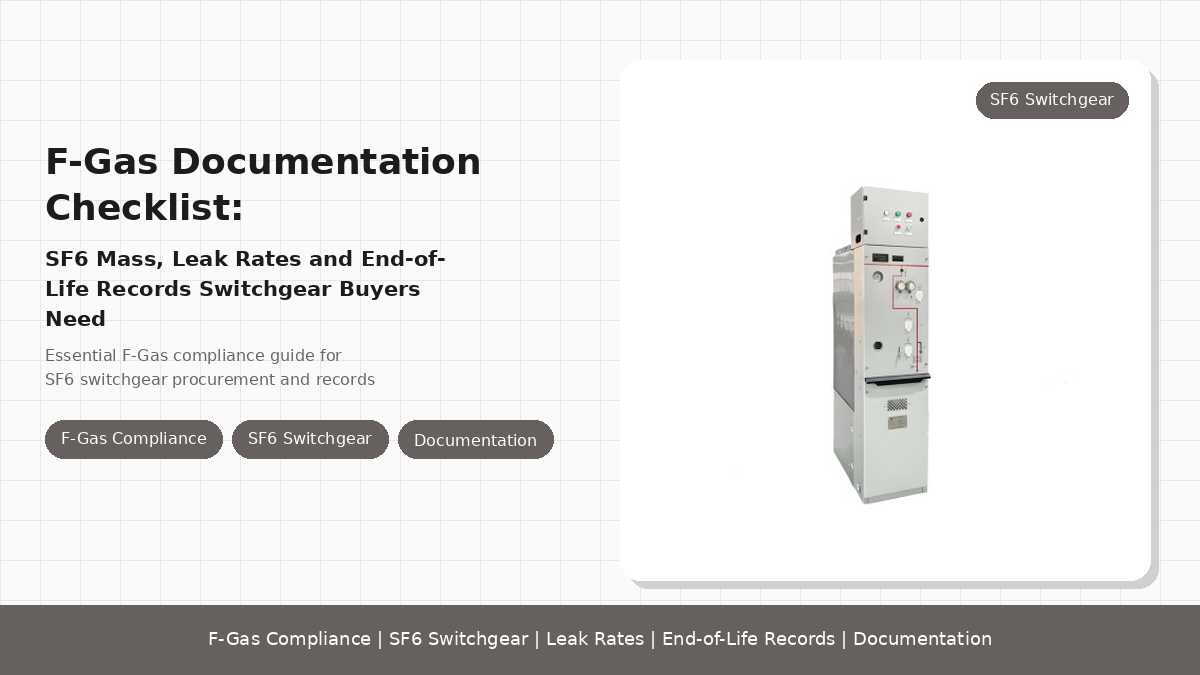
- Because SF6 is a fluorinated greenhouse gas with a very high global warming potential, replacing it with N2 removes the F-gas compliance, leakage reporting, and end-of-life recovery burden.
Short answer: A nitrogen-insulated metal-clad switchgear replaces SF6 by splitting the job in two. The dielectric field is held by dry air or N2 inside a sealed stainless-steel tank at a defined micro-positive pressure, and current interruption is handled by vacuum interrupters. Because the two functions are no longer carried by a single fluorinated gas, the panel can keep the same 12 kV ratings under IEC 62271-200 without derating, while the operator removes the F-gas compliance and recovery cost from the project. The XGTD8-12 is our concrete example of that design: sealed stainless-steel tank, N2 at low positive pressure, vacuum interruption, IP67 tank, and an annual leak rate at or below 0.1%. That is how the panel replaces SF6, not by lowering the bar.

Why replace SF6 in metal-clad switchgear at all?
Because SF6 is a fluorinated greenhouse gas with a global warming potential orders of magnitude higher than CO2. That single fact has reshaped how utilities, EPC contractors, and industrial buyers think about medium-voltage switchgear. The EU F-gas regulation already restricts SF6 in many medium-voltage applications, and several other regions have introduced reporting, leakage limits, or end-of-life recovery duties. Even where the regulation is lighter, the economic logic is the same: every kilogram of SF6 that escapes, every reclaimed kilogram at end of life, and every leak check visit has a cost.
For a switchgear buyer, the practical question is no longer “which gas gives the strongest dielectric field” but “which combination of design choices delivers the same ratings without the F-gas.” Nitrogen-insulated metal-clad switchgear is one of the answers that has matured fastest. The [Tianan gas-insulated switchgear lineup](https://www.tiananoverseas.com/environmentally-friendly-switchgear/) places the XGTD8-12 in the eco-friendly range, alongside air-insulated panels that suit different duty cycles.
How does nitrogen insulation replace SF6 without derating?
By splitting the dielectric job from the interruption job. In a classic SF6 panel, the same gas does two things: it insulates the open break, and it helps quench the arc. A nitrogen-insulated design assigns the first job to the gas and the second to a vacuum interrupter.
Vacuum interrupters are a well-understood technology. They extinguish the arc inside a sealed vacuum bottle, where the metal vapour condenses quickly and the dielectric strength recovers in microseconds. That makes them well suited to load current and short-circuit interruption. The gas outside the interrupter does not need to extinguish anything. It only has to hold the dielectric field between the open contacts and to earth. Dry air and nitrogen at modest positive pressure can do that job at 12 kV when the contact geometry and the insulation distance are designed for it.
Three engineering choices make this work in practice:
- A sealed stainless-steel tank. The primary live parts sit inside a welded stainless-steel enclosure with IP67 protection. The annual N2 leak rate is at or below 0.1%, so the pressure stays inside the design window for the life of the panel.
- A defined micro-positive pressure. The rated operating pressure is a small positive value (around 0.02 MPa on the XGTD8-12). That pressure is high enough to keep humidity out and to support the dielectric field, and low enough that the structure stays compact.
- A pressure gauge with alarm contact. The operator sees the safe pressure range and can interlock closing or opening at low pressure, so a slow leak becomes a service event rather than a safety event.
The XGTD8-12 product page lists several standards that the panel aligns with, including IEC 62271-200 for the metal-enclosed switchgear family, GB/T 3906 for AC metal-enclosed switchgear and controlgear up to 40.5 kV, and GB/T 11022 for common Hv Switchgear specifications. The fact that those references can stay the same is the clearest sign that the panel has not been derated. The [XGTD8-12 eco-friendly switchgear from China factory](https://www.tiananoverseas.com/china-xgtd8-12-indoor-n-gas-insulation-metal-clad-switchgear-suppliers-and-factory-eco-friendly-solution-product/) page carries the full parameter table for the panel.
Inside the XGTD8-12: what is actually inside the panel?
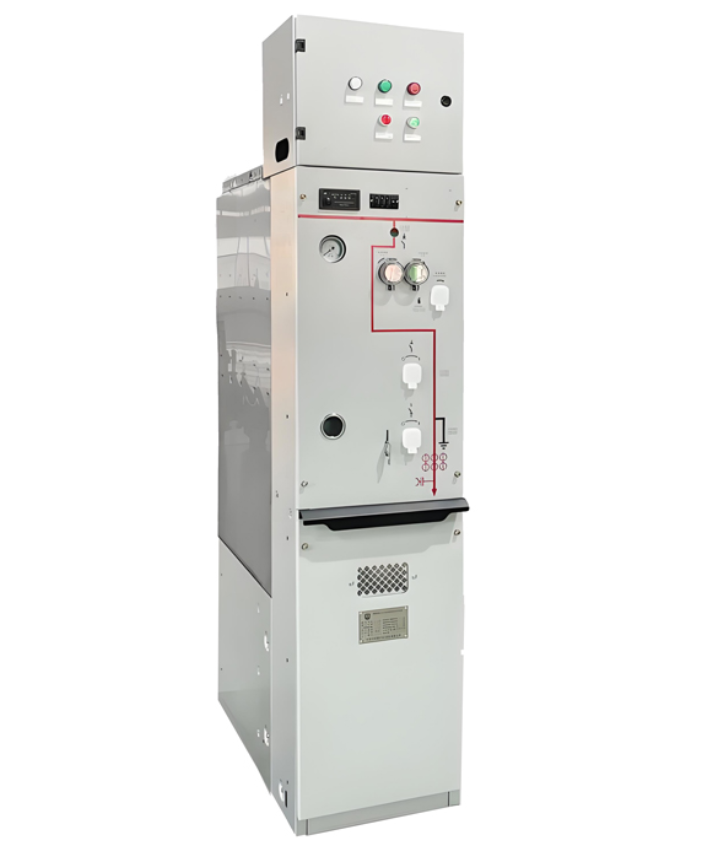
Five compartments arranged around a sealed gas tank.Reading the XGTD8-12 from the front of the unit, the secondary meter room sits on top for protection devices, ammeters, voltmeters, and the secondary terminals. Below it is the operating panel with the switch position indicators and the gas pressure gauge. The gas tank compartment is the heart of the design. It is fully welded stainless steel, sealed at IP67, and hosts the primary live parts, the busbars, and the three-position switch. Below the tank is the pressure-relief and cable compartment, which also acts as the arc-gas guide channel during an internal arc event. The cable room front door is the operator’s interface for HV cable work, and it is interlocked so it can only be opened when the Earthing Switch is closed and the circuit is dead.
| Parameter | Unit | Value |
|---|---|---|
| Rated voltage | kV | 12 |
| Rated current (CB / load switch) | A | 630 / 1250 · 630 |
| Rated frequency | Hz | 50 / 60 |
| 1 min power-frequency withstand voltage (phase-to-phase / phase-to-earth) | kV | 42 (insulation distance 48) |
| Rated lightning impulse withstand voltage (peak) | kV | 75 (insulation distance 85) |
| Rated short-circuit breaking current (rms) | kA | 20 / 25 |
| Rated short-circuit making current (peak) | kA | 50 / 63 |
| Rated short-time withstand current (4 s) | kA | 20 / 25 |
| Main circuit resistance per phase | µΩ | ≤ 160 |
| N2 rated operating pressure | MPa | 0.02 |
| Mechanical life (CB / load switch) | operations | 10 000 |
| Mechanical life (three-position switch) | operations | 5 000 |
| Internal arc class (IAC) | kA / s | 25 / 1 |
| Annual N2 leak rate | % | ≤ 0.1 |
| Protection degree (gas tank / other compartments) | - | IP67 / IP4X |
The footprint stays compact because the gas tank carries the dielectric work. The standard cubicle widths are 420 mm for C, V, and D units and 600 mm for the PT unit, with heights between 1950 mm and 2000 mm depending on whether the cable connection is on top or on the side. That is in the same range as a conventional 12 kV metal-clad cubicle, which matters for retrofit projects where the new panel must drop into an existing switchroom without civil works.
The environmental envelope of the XGTD8-12 is also wider than a typical indoor panel. The product page lists an ambient temperature range of −45 °C to +50 °C, an altitude limit of 4000 m (with a pressure adjustment above 1000 m), a daily-average relative humidity of 95%, and a seismic intensity up to grade 8. Those numbers matter because the gas tank design removes the sensitivity of the insulation to humidity, dust, and salt mist. The panel can sit in a coastal substation, a high-altitude wind farm step-up, or a metro tunnel where an air-insulated design would struggle.
How do the ratings line up with IEC 62271-200?
The XGTD8-12 is designed against the same set of tests as a conventional SF6 panel. IEC 62271-200 covers AC metal-enclosed switchgear and controlgear for rated voltages above 1 kV up to and including 52 kV, which is the family standard that any 12 kV metal-clad panel must satisfy. The parameter table on the XGTD8-12 page quotes values that are read directly into that framework:
- Rated voltage 12 kV and rated frequency 50 / 60 Hz match the common 12 kV secondary-distribution service.
- The 1 min power-frequency withstand voltage of 42 kV phase-to-phase / phase-to-earth and the lightning impulse withstand voltage of 75 kV peak define the dielectric envelope.
- The short-time withstand current of 20 / 25 kA for 4 s and the peak withstand current of 50 / 63 kA cover the through-fault duty on a typical 12 kV bus.
- The internal arc class of 25 kA / 1 s provides an arc-flash containment rating that allows installation in occupied switchrooms when the access conditions in the standard are followed.
- The mechanical life of 10 000 operations for the circuit breaker and load switch, and 5 000 operations for the three-position switch, support a long service interval.
| Duty point | Classic SF6 metal-clad | XGTD8-12 nitrogen-insulated |
|---|---|---|
| Insulating medium | SF6 at a defined pressure | Dry air or N2 at a defined micro-positive pressure |
| Current interruption | SF6 or vacuum (panel-dependent) | Vacuum interrupter |
| Tank sealing | Welded, gasket-sealed, leak-checked | Welded stainless steel at IP67, ≤ 0.1% / yr |
| Annual leak inspection | Required, with SF6-specific reporting | Optional routine pressure check |
| F-gas reporting burden | Yes, where F-gas rules apply | None, nitrogen is not an F-gas |
| End-of-life gas recovery | Required, with certified recovery | Vent to atmosphere, no special recovery |
| Rated voltage | 12 kV | 12 kV |
| Short-time withstand current | Up to 25 kA / 4 s in the class | 20 / 25 kA / 4 s |
| Internal arc class | Up to 25 kA / 1 s in the class | 25 kA / 1 s |
The comparison is not a claim that nitrogen-insulated switchgear is “better” than SF6 on every axis. SF6 still has a place in some higher-voltage and higher-rupturing-capacity applications, and the user’s network conditions should drive the choice. The point is narrower: at 12 kV, a nitrogen-insulated metal-clad panel can keep the same family ratings and remove the F-gas from the project at the same time.
How does the XGTD8-12 fit into an existing switchroom?
Often with no civil works at all. The XGTD8-12 standard cubicle widths (420 mm for C / V / D units and 600 mm for the PT unit) match the row width of a typical 12 kV switchboard. The cable interface uses the same DIN 47636-style bushings and the same fully insulated, fully shielded separable connectors that are common on 12 kV panels, so the existing cable terminations can usually be re-used. The bus connection can be configured for either top or side entry, which gives the layout engineer two ways to fit the new panel into the available cable trench.
Three practical retrofit checks are worth doing before the switchgear order is frozen:
- Confirm the existing switchroom floor loading and cable trench depth. The XGTD8-12 depth is 850 mm and the height is up to 2000 mm. The trench must accept the bottom-entry cable bend and the arc-gas guide channel.
- Confirm the existing busbar rating. If the new panel is replacing one cubicle in a longer row, the through-bus must carry the rated current of the new panel; otherwise the row rating drops to the old bus.
- Confirm the protection scheme. The secondary meter room follows the conventional protection wiring, so existing relays and SCADA maps can usually be reused. Where the protection logic changes, the panel-side wiring needs a project-specific review.
For greenfield sites, the same numbers reduce the building cost. A smaller footprint means a smaller switchroom, and a smaller switchroom means less air-conditioning load in hot climates. Over the life of the substation, those savings sit alongside the avoided SF6 reporting cost.
What sits behind the XGTD8-12 in R&D and quality control?
An export-grade R&D pipeline, quality system, and information platform.The [Tianan R&D behind our SF6-free designs](https://www.tiananoverseas.com/our-advantage/) page sets out the company’s R&D and innovation practice: continuous investment in people, technology, and equipment, with a focus on intelligent electric, green energy electric, rail transportation electric, and urban-rural power distribution. Tianan’s own description covers self-developed products such as prefabricated substations, ring main units, load break switches, wind power switching equipment, and intelligent Power Grid systems.
For the buyer, three things follow from that R&D posture:
- Quality system. The company runs ISO 9001 for quality management, ISO 14001 for environmental management, and OHSAS 18001 for occupational health and safety. The scope covers design, technique, manufacture, inspection, supply, sales, service, environment, safety, and health across the organisation.
- Testing depth. The factory imports advanced production and testing instruments, and the company holds an annual “quality month” to reinforce quality training. The aim is to keep the design review and the production test aligned with the standards cited on the XGTD8-12 product page.
- Information platform. A VPN-based integrated platform connects ERP, CAD / CAM / CAPP / PDM, disaster recovery and backup, intelligent protection, office automation, and business intelligence. That is what makes a multi‑standard product line like the XGTD8-12 maintainable across its service life.
The R&D pipeline is the part a buyer rarely sees. The R&D input and the testing depth explain why the XGTD8-12 keeps its 12 kV ratings on N2 instead of asking the user to accept a smaller panel. They also explain why the IEC 62271-200 family standard, the GB/T 3906 standard for AC metal-enclosed switchgear up to 40.5 kV, and the GB/T 11022 common HV specification sit comfortably on the same parameter sheet.
What is the next step with Tianan Overseas?
Send the panel specification and we will work backward to the right configuration. A short technical message with the rated voltage, rated current, short-circuit level, number of panels, busbar scheme, and the cable entry direction is usually enough to start a useful conversation. From there, our team in Ningbo can confirm the cubicle widths, the matching PT unit, the busbar rating, the protection wiring, and the special-service options such as high-altitude pressure adjustment or seismic-grade mounting.
For utility and infrastructure projects across Asia, Africa, the Middle East, and South America, the export cycle usually involves three documents: the panel data sheet, the single-line diagram, and the switchroom layout. With those in hand, we can confirm whether the XGTD8-12 drops into the existing footprint or whether a custom configuration is needed.
Talk to Tianan Overseas about the XGTD8-12
Send your single-line diagram, switchroom layout, and the destination market. We will confirm ratings, footprint, and the right gas pressure for your site.
Contact: overseas@tianandl.com · Tel: +86-574-87916011 · 3rd Floor, Building B7, No. 999 Yangfan Road, High-Tech Zone, Ningbo, Zhejiang, China
See the eco-friendly switchgear lineup · XGTD8-12 product page · Our R&D and quality system
Authoritative references
- IEC 62271-200, AC metal-enclosed switchgear and controlgear for rated voltages above 1 kV and up to and including 52 kV: family standard referenced by the XGTD8-12 parameter table.
- GB/T 3906, AC metal-enclosed switchgear and controlgear for rated voltages above 3.6 kV and up to and including 40.5 kV: Chinese national standard cited on the product page.
- GB/T 11022, Common specifications for high-voltage switchgear and controlgear standards: referenced for the cross-cutting HV switchgear specification.
- Tianan Overseas, Environmentally Friendly Switchgear: overview of the eco-friendly switchgear lineup that includes the XGTD8-12.
- Tianan Overseas, XGTD8-12 Indoor N2 Gas Insulation Metal-clad Switchgear: product page with the full parameter table and standards list.
- Tianan Overseas, Our Advantage: company R&D, quality, after-sales, and information platform description.