
0102030405
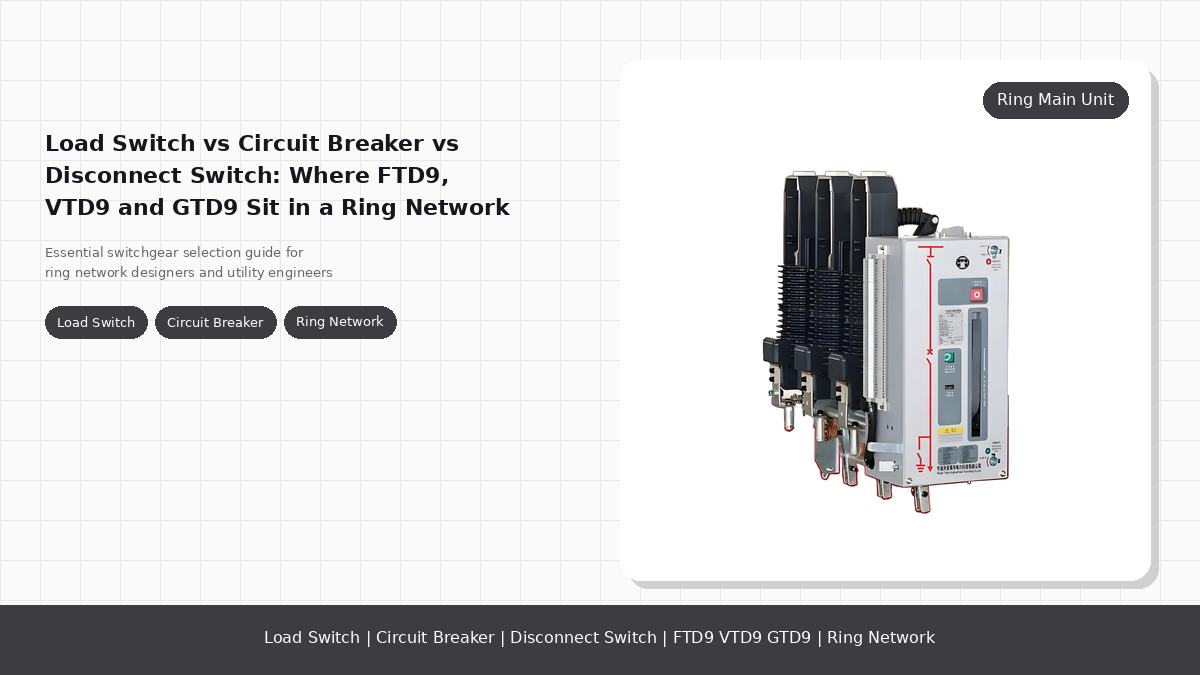
Load Switch vs Circuit Breaker vs Disconnect Switch: Where FTD9, VTD9 and GTD9 Sit in a Ring Network
2026-11-03
Quick answer
- A load switch switches the circuit; it does not interrupt the fault. The FTD9-12D is rated 12 kV and 630 A, with a 20 kA for 4 s short-time withstand and no assigned breaking current.
- A circuit breaker is the only one of the three that clears a fault. The VTD9-12D is rated 20, 25 or 31.5 kA breaking current and 50, 63 or 80 kA peak making current, opening in 45 ms maximum.
- A disconnect switch isolates for maintenance, with a gap you can see. The GTD9-12D publishes 125 ± 1 mm clearance between open contacts, against 9 ± 1 mm on the load switch and the breaker.
- A ring network unit normally needs all three, in different positions. The breaker protects, the load switch does the routine tie switching, and the disconnect switch makes the panel safe to work on.
- One cabinet width, three devices. The FTD9, VTD9 and GTD9 share identical external dimensions and a 500 mm cabinet width, so one line-up can mix them without redesigning the switchboard.
What Is the Actual Difference Between the Three?
A load switch, a circuit breaker and a disconnect switch are three different devices, not three grades of one device, and the cheapest is never a substitute for the most expensive. The circuit breaker is the only one that can interrupt a short circuit. The load switch can carry one for a limited time but cannot clear it. The disconnect switch opens and closes no-load current only, and exists to create a visible isolation gap.
The published ratings make that line concrete. The FTD9-12D load switch is rated 12 kV and 630 A with a 20 kA for 4 s short-time withstand, and its rated short-circuit breaking current is not assigned — the sheet reads "/" because the product does not claim it. The VTD9-12D breaker, in the same cabinet width, is rated 20, 25 or 31.5 kA breaking current, while the GTD9-12D disconnect switch carries 630 A or 1250 A with no breaking capability.
The second difference is physical, and it is the one your safety rules depend on. The disconnect switch publishes 125 ± 1 mm clearance between open contacts. The load switch and the breaker publish 9 ± 1 mm, with a contacting travel of 5.5 ± 1 mm and a closing bounce time of 2 mm maximum.
The standards draw the same line. According to IEC 62271-103, a load switch is defined around carrying a fault rather than interrupting it, and IEC 62271-102 covers disconnect switches as a separate product altogether. In North America, IEEE C37.010-2016 treats the circuit breaker as the reference point for protective coordination.
This is the decision that gets made on the quotation and discovered on the network.A ring main unit ordered with Load Switches because the quotation was lower leaves nothing in the cubicle to interrupt the first ring fault, so the choice is worth settling in the specification rather than in the tender.
What Each Device Does Inside a Ring Network
In a normally-open ring network unit, the three devices cover three different moments in the life of the circuit. The circuit breaker is what you rely on when something fails downstream, because it is the only device in the cubicle that can clear the fault. The load switch is what you operate routinely, opening and closing a ring tie. The disconnect switch is what you operate before anyone touches the panel.
The ring structure is what makes the combination necessary. A ring main unit has an incomer way, an outgoing way and a tie way, and normally the ring runs open so a fault on one section does not feed the whole loop. A fault must therefore be cleared at both ends of the affected section, so the interruption duty cannot be delegated to a device that cannot interrupt. Routine switching is constant, so mechanical life matters as much as electrical rating.
Where a load switch is used instead of a breaker, the fault interruption moves into a fuse. Our FTD9-12RD combination apparatus uses three pole load switches with three fuses fitted with impactors, and the action of any one impactor opens all three poles. That is a legitimate design with a different maintenance profile, because the fuses are sacrificial and the switching does not depend on vacuum arc quenching.
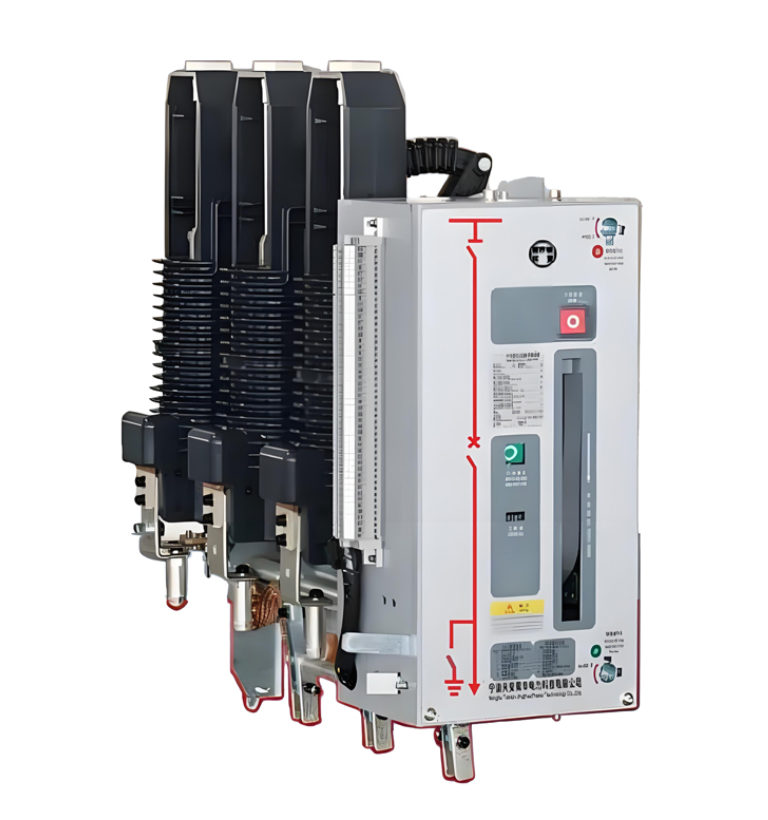
The dimension consistency is the quiet benefit. The FTD9 load switch, the VTD9 breaker and the GTD9 isolating switch we publish share identical external dimensions and a cabinet width of only 500 mm. For a contractor, the same panel, mounting frame and bus arrangement accept any of the three, so the device choice does not force a re-layout.
FTD9, VTD9 and GTD9 Side by Side
Here are the three published data sets placed against each other, so the decision is made on ratings rather than on descriptions. All three are 12 kV indoor air-insulated units for three-phase 50/60 Hz systems with the same 42 kV power frequency withstand voltage for one minute and the same 75 kV lightning impulse withstand voltage, rising at the isolating fracture to 48 kV and 85 kV.
| Parameter | FTD9-12D load switch | VTD9-12D Circuit Breaker | GTD9-12D disconnect switch |
|---|---|---|---|
| Rated current | 630 A | 630 A / 1250 A | 630 A / 1250 A |
| Rated short-circuit breaking current | not assigned | 20 / 25 / 31.5 kA | not assigned |
| Rated short-time withstand current | 20 kA / 4 s | 20 / 25 / 31.5 kA / 4 s | 20 / 25 / 31.5 kA / 4 s |
| Rated peak withstand current | 50 kA | 50 / 63 / 80 kA | 50 / 63 / 80 kA |
| Main circuit resistance per phase | ≤ 100 mΩ | ≤ 80 mΩ / ≤ 70 mΩ | ≤ 45 mΩ / ≤ 40 mΩ |
| Clearance between open contacts | 9 ± 1 mm | 9 ± 1 mm | 125 ± 1 mm |
| Opening / closing time at rated voltage | not assigned | ≤ 45 ms / ≤ 70 ms | not assigned |
| Mechanical life | 5,000 operations | 10,000 operations | 3,000 operations |
| Cabinet width | 500 mm | 500 mm | 500 mm |
Read the table as three answers to three questions. The breaking current row answers who interrupts the fault. The clearance row answers what keeps the operator safe while the panel is open. The mechanical life row answers what survives a decade of routine tie switching.
What It Costs to Specify the Wrong One
The cost difference between the three is real, and the specification difference is larger, because the saving moves the fault interruption somewhere else. A load switch cubicle is built around an interrupter that cannot break the fault, so the interruption has to be bought as fuses, upstream protection, or both, and the saving on the cubicle is paid for in coordination studies.
Putting our own three published data sets side by side produces a simple ratio. The VTD9-12D is the only unit of the three with an assigned short-circuit breaking current, and it carries twice the mechanical life of the load switch at 10,000 operations against 5,000, and more than three times the life of the disconnect switch at 3,000. It is also the only one publishing an operating time.
The second cost lands during commissioning. A unit specified with load switches needs fuse coordination, fuse holders and an arc assessment; a unit specified with breakers needs the protection coordination study and the relay settings. Both are real engineering hours, and both are cheaper done once in the specification than corrected after the equipment is built.
I will not claim the breaker is always right. On a low fault-level network a fuse combination can be more economical, and for a small outgoing feeder a load switch with a fuse is often better engineering than a breaker with a relay. What is always wrong is substituting one device for the other after the quotation, because the capability has to be in the cubicle before the fault arrives.
How to Specify the Right Device for Your Ring Network
Five questions, answered in this order, settle the device for each position in the line-up.
- Establish the fault level at each node. Obtain the maximum short-circuit current for every point in the ring, and compare it with the breaker's rated breaking current (20, 25 or 31.5 kA) and the withstand of the device fitted.
- Decide who interrupts the fault. If the unit must clear the fault itself it needs an interrupter such as the VTD9-12D. If clearing is delegated to fuses or upstream protection, the load switch is correct.
- Establish the isolation requirement. Maintenance access, lock-off and the visible-break requirement decide whether a disconnect switch belongs in that cubicle, and the GTD9-12D gives 125 ± 1 mm of clearance for that duty.
- Count the operations, not the years. Compare the published mechanical life of 10,000, 5,000 or 3,000 operations against the switching duty the position will see in its service life.
- Check the cabinet and the secondary system together. All three devices share a 500 mm cabinet width and identical dimensions, so confirm the misoperation-prevention interlocking is integrated with the operating mechanism, and settle the relay, protection and SCADA scheme first.
What to Check Before the Equipment Ships
Three items on the published data deserve a second look before you sign the order, starting with the service conditions. All three units in our range are rated for -25 °C to +40 °C ambient, altitudes up to 1000 m, daily average relative humidity up to 95 % and seismic intensity up to 8. A site above 1000 m or outside that band needs a derating discussion at quotation stage.
Second, the standards basis, because it has to match the destination market. The FTD9 load switch is published against IEC 62271-103, IEC 62271-105, GB/T 3804 and GB/T 16926; the VTD9 breaker against IEC 62271-1, IEC 62271-100, GB 1984, GB/T 11022, DL/T 402 and JB/T 3855; the GTD9 disconnect switch against IEC 62271-1, IEC 62271-102, GB/T 1985 and GB/T 11022. In North America the applicable code is the NFPA 70 National Electrical Code; in Europe the panel is built to IEC 62271-200.
Third, the mechanical and short-circuit integrity of the installation. The published contact pressure of 1000 ± 100 N on the load switch, against 2400 ± 200 N on the breaker at 20-25 kA and 3100 ± 200 N at 31.5 kA, is a figure to check rather than argue about. Ask for the type test certificates matching the rating you ordered, and confirm the measured main circuit resistance is at or below the published value.
The one document I ask for before we quote a ring main unit is the single-line diagram with the fault level marked at each node. It takes an afternoon, and it decides whether the cubicle at the end of the ring needs a 25 kA breaker or a load switch with a 20 kA for 4 s withstand.
Frequently Asked Questions
1. Can a load switch break a short circuit?
No. The FTD9-12D publishes its rated short-circuit breaking current as not assigned, because a load switch is not built to interrupt a fault. It publishes instead a 20 kA for 4 s short-time withstand, so it can hold a fault until a fuse or an upstream breaker clears it. If the cubicle must interrupt the fault, it needs an interrupter such as the VTD9-12D.
2. What is the difference between a disconnect switch and an isolating switch?
They describe the same function in two naming conventions. Under the IEC 62271 series the device is an isolating switch under IEC 62271-102, and in North American utility and IEEE vocabulary the same function is written as disconnect switch. Our own switch category lists both terms, and the GTD9-12D is published as an indoor high voltage AC isolating switch rated 630 A or 1250 A.
3. Which device does a ring network unit actually need?
Usually more than one, and the combination is what most specifications get wrong. The breaker provides fault interruption at each point of the ring, the load switch handles routine switching and tie-making, and the disconnect switch provides the visible isolation for maintenance. Because all three share identical dimensions and a 500 mm cabinet width, they can sit in one line-up.
4. Can I use a load switch instead of a circuit breaker to save money?
Sometimes, and it is the right answer in some designs. A load switch with a fuse combination, such as our FTD9-12RD, interrupts the fault through fuses fitted with impactors, where the action of any one impactor opens all three poles. A plain substitution after the quotation is not acceptable: a load switch with no assigned breaking current leaves nothing in the cubicle to clear the fault.
5. Are the FTD9, VTD9 and GTD9 interchangeable in the same cabinet?
Externally, yes. All three are published with identical external dimensions and a cabinet width of only 500 mm, and they are designed to be combined and expanded in the same switchgear line-up. Electrically, no: they have different ratings, interrupting capability and isolation distances, so the panel build and the protection scheme must match the device in that position.
6. What are the service condition limits for these units?
For the FTD9-12D, VTD9-12D and GTD9-12D the published service conditions are ambient temperature from -25 °C to +40 °C, altitude up to 1000 m, daily average relative humidity up to 95 %, and seismic intensity up to 8. If the site sits above 1000 m or outside that temperature band, raise it at quotation stage.
Need a ring main unit line-up specified against your network?
Send us the single-line diagram with the fault level marked at each node, the duty of each position and the destination country, and we will return a specified line-up with published ratings and a written quotation.
Request a ring network quotation