
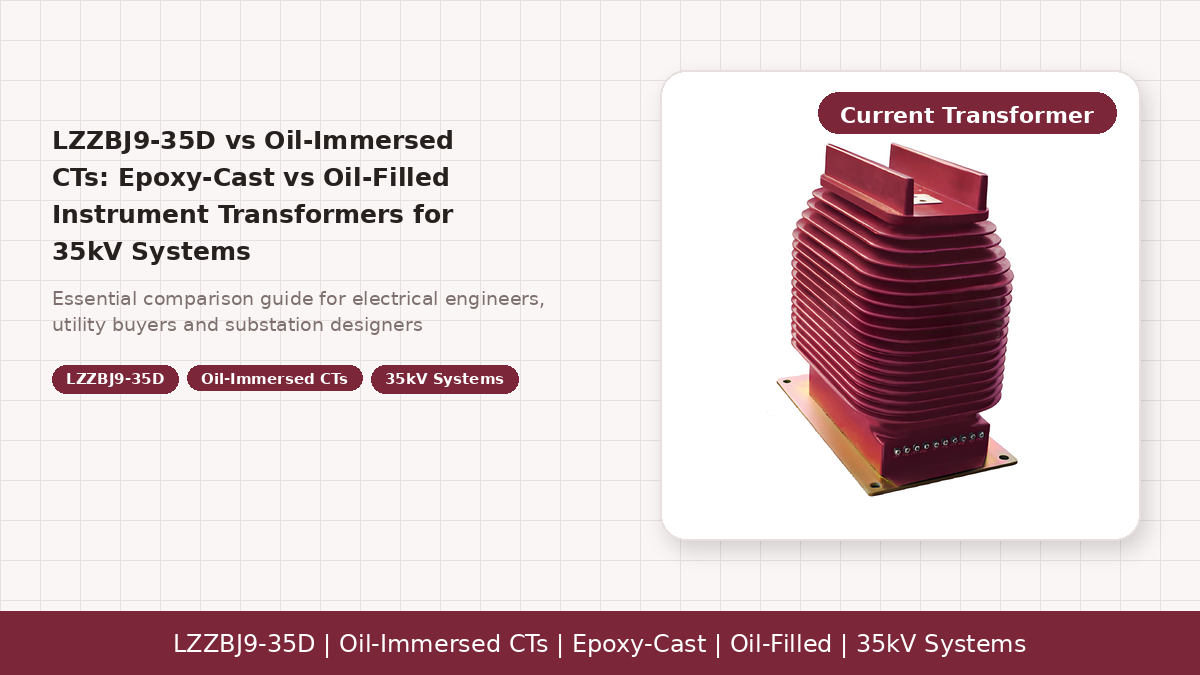
- The LZZBJ9-35D epoxy-cast CT and the 35kV oil-immersed CT family are both qualified to IEC 61869-1 and IEC 61869-2, but they are not direct substitutes — they target different substation problems.
- Epoxy cast (LZZBJ9-35D) wins on fire safety, indoor footprint, and switchgear panel mounting; oil-immersed wins on dielectric margin, higher primary current, and outdoor substation service.
- Pick by substation layout first (indoor switchgear vs outdoor substation), then by primary current, then by accuracy class, then by standards scope.
- The fire-safety and environmental envelope is the second most expensive procurement input after the standards pack — lock it before the first quote.
- Use the four-step decision workflow at the end of the article to lock the right 35kV CT for your project.
What is actually the difference between an epoxy-cast and an oil-immersed CT?
Most buyers open a procurement conversation by asking which is better. The right opening question is which substation problem the CT has to solve — because the LZZBJ9-35D epoxy-cast CT and the 35kV oil-immersed CT family solve different problems, and the answer is set by the substation layout, not by the material preference.
Solid insulation vs oil dielectric
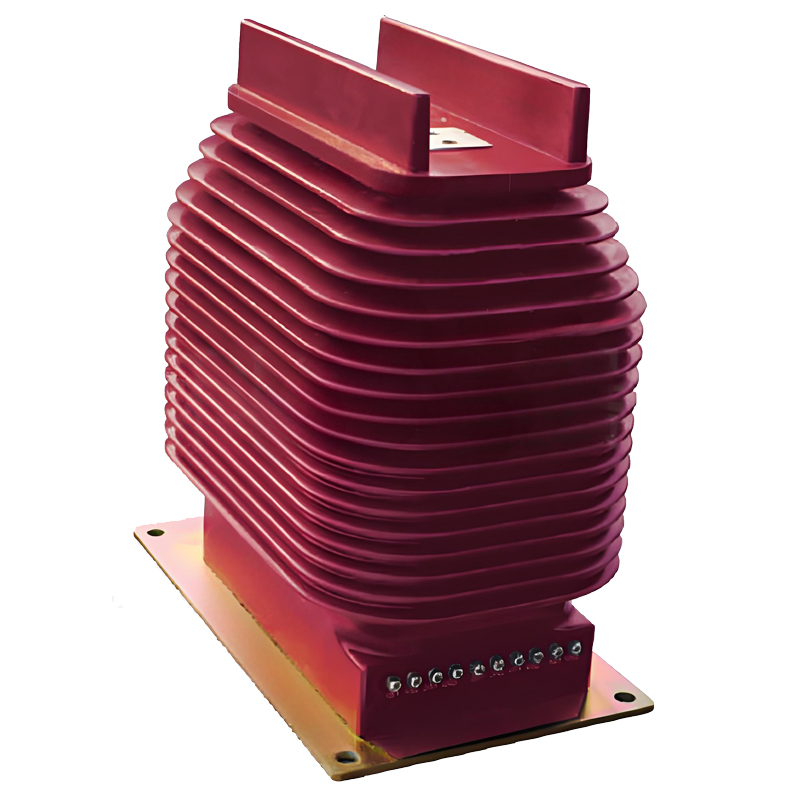
The dielectric medium is the fundamental engineering difference. An epoxy-cast current transformer such as the LZZBJ9-35Duses solid epoxy resin to insulate the primary winding from the secondary and to provide the dielectric strength needed for the rated voltage. An oil-immersed current Transformer Uses mineral oil (or, less commonly, SF6 gas) as the dielectric medium inside a steel tank, with the active core-and-coil assembly immersed in the oil. Both approaches are qualified to the same standard envelope, but the lifecycle, the fire-safety profile, the footprint, and the maintenance regime are different.
Why the difference matters for procurement
For the procurement call, the difference between the two approaches is a set of binary trade-offs: indoor vs outdoor, panel-mount vs free-standing, fire-load vs oil-containment, compact dielectric margin vs extended dielectric margin. None of these trade-offs is a one-line answer — the right CT depends on which trade-off the substation can accept, and a buyer who specifies the CT before locking the substation layout pays for the wrong choice on the next rebuild.
What standards apply to a 35kV CT shipped internationally?
The standards pack is the single most important documentation input for a 35kV CT export order, and it is the part that the buyer has to lock before the first quote. The two IEC standards — IEC 61869-1 and IEC 61869-2 — define the global framework, but the regional standards and the documentation pack vary by destination, and the buyer who specs a CT to the wrong standard pays for the rebuild at the utility acceptance test.
IEC 61869-1 and IEC 61869-2 as the global framework
The primary standard pair is IEC 61869-1 (general requirements for instrument transformers) and IEC 61869-2 (complementary requirements for current transformers). According to the CEN-CENELEC European standards framework, IEC 61869 is the harmonised European standard for instrument transformers, and the same standard is the global baseline for utility acceptance testing in most markets outside North America. A CT built to IEC 61869-1 / -2 will pass the type test in most destination countries, with the right regional deviation attached.
Regional deviations: GB, JJG, IEEE, and others
Region-specific standards add detail on top of the IEC baseline. The LZZBJ9-35D in our catalog is qualified to GB 311.1 (insulation coordination), GB 5583 (partial discharge measurement), GB/T 22071.1 (current-transformer test guidelines), and JJG 1021 (verification regulations) — these are the Chinese national standards and the international standards map cleanly through the IEC 61869 pair. For US destinations, IEEE C57.13 is the relevant standard; for older projects, IEC 60044-1 (now superseded by IEC 61869) is still referenced. The procurement call has to specify the destination so the right standards pack is quoted.
What the documentation pack actually contains
For a 35kV CT export order, the documentation pack should include the type test report (per IEC 61869-2), the routine test report, the calibration certificate, the accuracy-curve data, the partial-discharge measurement, the rated insulation level declaration (40.5/95/185 kV for the LZZBJ9-35D indoor class), and the dimensional drawing. The documentation pack is the buyer's evidence that the CT will pass the destination utility's acceptance test, and a missing or partial pack is the most common reason a 35kV CT shipment is held at customs or rejected on commissioning.
Why is the LZZBJ9-35D the right answer for indoor switchgear?
For indoor 35kV switchgear, the LZZBJ9-35D is engineered to solve the four problems that an oil-immersed CT does not: footprint, fire load, oil containment, and panel-mounting. Each of the four is a hard constraint on an indoor Substation Design, and the LZZBJ9-35D is the answer to all four at once because solid epoxy insulation is the dielectric medium that does not need a tank, oil, or a containment pit.
Footprint and panel-mounting
The LZZBJ9-35D is a fully enclosed epoxy-cast product designed to be installed in any position and direction inside an air-insulated switchgear panel. The compact size and light weight (typical epoxy-cast CT in this rating class is on the order of 25–50 kg) make panel-mounting practical, and the primary conductor passes through the central window of the CT with the secondary terminals brought out to a side terminal block — a layout that an oil-immersed CT cannot match because the oil tank has to remain sealed and upright.
Fire safety and the oil removal
Epoxy-cast CTs are solid insulation — there is no oil or SF6 to leak, burn, or require spill containment. An oil-immersed CT carries a small volume of mineral oil that, in the event of a tank rupture, can ignite and produce a sustained pool fire. For indoor substations, basements, and tunnels where fire load is a project risk, the epoxy-cast construction removes the oil risk and usually removes the oil-spill containment requirement from the civil works — which is a real civil-cost saving that the procurement decision rarely captures.
What the oil-immersed family still does better
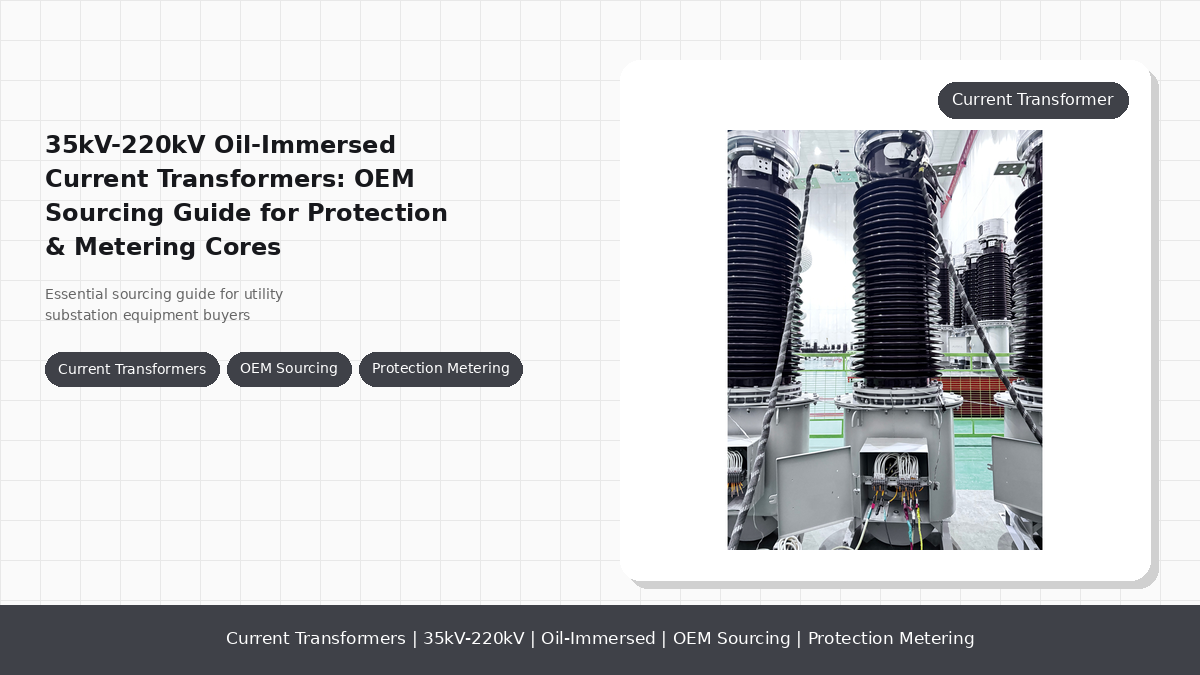
Oil-immersed CTs do retain real advantages in three areas: dielectric margin, free-standing outdoor substation construction, and higher primary current ranges. For an outdoor 35kV free-standing substation, the oil-immersed vertical CT family in our catalog (35kV–220kV range) is the right answer — it is a self-supporting steel-tank construction, it has a higher dielectric margin, and the oil provides passive convection cooling that the epoxy cast does not need indoors.
| Dimension | LZZBJ9-35D epoxy-cast indoor CT | 35kV oil-immersed vertical CT |
|---|---|---|
| Installation | Indoor switchgear panel, any orientation | Outdoor substation, free-standing, upright |
| Rated insulation level | 40.5/95/185 kV (indoor class) | 40.5/95/185 kV and up (outdoor class) |
| Primary current range (typical) | 20–1250 A (per catalog) | Higher ranges; commonly 600–3150 A |
| Accuracy class | 0.2(S), 0.5(S), 5P20, 5P25, 5P30 | 0.2(S), 0.5(S), 5P20–5P40 (depending on rating) |
| Fire-safety envelope | No oil, no SF6 — fire-load neutral | Mineral oil; oil-spill containment in civil works usually required |
| Footprint | Compact, panel-mounted | Free-standing tank; requires civil foundation |
| Maintenance | Solid insulation — minimal | Periodic oil inspection / sampling over the asset life |
| Best-fit substation type | Indoor switchgear, basement, tunnel, indoor AIS panel | Outdoor substation, free-standing yard, higher-current line bays |
| Standards | IEC 61869-1/-2, GB 311.1, GB 5583, GB/T 22071.1, JJG 1021 | IEC 61869-1/-2 plus outdoor dielectric coordination (pollution, altitude) |
What does the LZZBJ9-35D actually deliver at 35kV?
The LZZBJ9-35D is not a generic indoor CT — the technical-data sheet defines a specific envelope of primary current, accuracy class, short-time thermal current, and rated output that the buyer has to lock before the order. Locking these four values together is the difference between a CT that passes the utility acceptance test and one that has to be re-spec'd at commissioning.
Rated insulation and dielectric margin
The LZZBJ9-35D has a rated insulation level of 40.5/95/185 kV, which corresponds to a 35kV rated voltage with the standard 95 kV power-frequency withstand and 185 kV lightning-impulse withstand for indoor 35kV switchgear. This is the standard insulation level for indoor 35kV CTs per GB 311.1 and is the same envelope that IEC 61869-2 specifies for indoor instrument transformers at 35kV — the buyer does not need to over-spec the dielectric margin for an indoor application.
Primary current and accuracy class combinations
The LZZBJ9-35D supports primary current from 20A up to 1250A in the standard catalog range, with measurement accuracy classes 0.2(S) and 0.5(S) for revenue-metering and load-survey duty, and protection classes 5P20, 5P25, and 5P30 for relay protection. Accuracy class combinations (e.g. 0.2(S)/5P, 0.5(S)/5P, 0.2(S)/0.5(S)/5P, and 0.2(S)/0.5(S)/5P/5P) drive the core size and the secondary winding layout; the right combination depends on the meter's accuracy requirement and the protection relay's stability class, not on the CT's dielectric rating.
Short-time thermal current and dynamic current
The short-time thermal current (Ith) is the key protection-side parameter — for the LZZBJ9-35D family, typical Ith values are 25 kA/1s for primary current 20–100A and 31.5 kA/1s for 200A and above. Locking Ith to the project's protection-study output is the single most expensive mistake to avoid in the CT spec — an under-rated CT passes the inrush but trips on the through-fault current, and an over-rated CT costs the project on the core size and the secondary wiring.
What about oil-immersed CTs at higher voltage?
For 35kV, oil-immersed CTs are not the default — epoxy cast is more cost-effective for indoor switchgear. But for higher voltage (66kV, 110kV, 220kV) and for outdoor substations, the oil-immersed family is the right answer, and the 35kV oil-immersed CT is often a procurement mix with the higher-voltage oil-immersed units in the same substation.
Where oil-immersed wins outright
Oil-immersed CTs win outright at higher primary current (above ~2000A), at higher voltage (66kV and above where the indoor insulation level no longer fits the panel), and at outdoor substations where the free-standing construction is part of the yard layout. The 35kV–220kV vertical oil-immersed CT family in our catalog is the procurement option for these cases, and the epoxy-cast LZZBJ9-35D is the procurement option for the indoor 35kV switchgear panels that sit in front of the oil-immersed units.
What the project mix usually looks like
A typical 35kV indoor substation uses LZZBJ9-35D epoxy-cast CTs across all the switchgear panels and reserves the oil-immersed family for the incoming line bays at higher primary current. The right procurement call is to specify both at the same time so the documentation pack, the standards scope, and the commissioning spare-parts list are aligned across the two technologies.
How do you choose between epoxy-cast and oil-immersed for a 35kV project?
The procurement call is not a single decision — it is a four-step process that ends in two POs (one for the indoor switchgear and one for the outdoor substation). Mixing the two is normal; the rule is to keep them separate in the documentation pack and the spare-parts inventory so the maintenance crew is not surprised at commissioning.
Map the substation layout first
Map the substation layout before the first quote. Decide first whether the CT is going into an indoor switchgear panel (LZZBJ9-35D), a free-standing outdoor substation (oil-immersed vertical), or a basement / tunnel installation (LZZBJ9-35D, because the fire-safety envelope is the binding constraint). Mixing the two in the wrong substation type is the most common procurement mistake in this category.
Lock the primary current and the accuracy class
Lock the primary current and the accuracy class before the first quote. For 35kV indoor applications up to about 1250A, the LZZBJ9-35D covers the typical range with accuracy classes 0.2(S), 0.5(S) and protection classes 5P20, 5P25, 5P30. Above 1250A primary, the oil-immersed family is the practical answer. Accuracy class combinations (e.g. 0.2(S)/5P) drive the core size and the secondary winding layout.
Lock the standards scope and the documentation pack
Lock the standards scope (IEC 61869-1 and -2 plus any regional deviation) and the documentation pack (type test report, routine test report, calibration certificate, accuracy curve) before the first quote. The documentation pack is the buyer's evidence that the CT will pass the destination country's utility acceptance test — and the right time to lock it is before the CT is built, not at the customs broker.
Lock the fire-safety and environmental envelope
Lock the fire-safety envelope before the order. Indoor switchgear, basements, and tunnels are usually better served by epoxy-cast CTs because there is no oil or SF6 to leak or burn. Outdoor substations with proper civil oil containment are well served by the oil-immersed family. The environmental envelope (altitude, ambient temperature range, humidity, pollution level) drives the dielectric margin and the creepage distance — and on indoor switchgear, the standard indoor creepage is usually sufficient.
Frequently asked questions
What is the difference between an epoxy-cast and an oil-immersed current transformer?
An epoxy-cast current transformer (such as the LZZBJ9-35D) uses a solid epoxy resin body to insulate the primary winding from the secondary and to provide the dielectric strength needed for the rated voltage. An oil-immersed current transformer uses mineral oil (or, less commonly, SF6 gas) as the dielectric medium inside a steel tank, with the active core-and-coil assembly immersed in the oil. The two approaches are both qualified to IEC 61869-1 and IEC 61869-2, but they target different substation layouts — epoxy cast for indoor switchgear and compact installations, oil-immersed for outdoor substations and higher primary current.
Is the LZZBJ9-35D suitable for outdoor installation?
The LZZBJ9-35D is designed as an indoor product. The LZZBJ9-35D spec sheet on our catalog lists it as a fully enclosed epoxy resin casting product for indoor switchgear, with operating temperature down to -5°C and relative humidity up to 95% average per 24h. For outdoor 35kV substation duty, the oil-immersed vertical CT family in our 35kV–220kV line is the right answer.
What is the rated insulation level of the LZZBJ9-35D?
The LZZBJ9-35D has a rated insulation level of 40.5/95/185 kV (per IEC 60060), corresponding to a 35kV rated voltage with the standard 95 kV power-frequency withstand and 185 kV lightning-impulse withstand for indoor 35kV switchgear. This is the standard insulation level for 35kV indoor current transformers per GB 311.1.
What accuracy classes are available on the LZZBJ9-35D?
The LZZBJ9-35D supports measurement accuracy classes 0.2(S) and 0.5(S) for revenue-metering and load-survey duty, and protection classes 5P20, 5P25, and 5P30 for relay protection, in combinations such as 0.2(S)/5P, 0.5(S)/5P, 0.2(S)/0.5(S)/5P, and 0.2(S)/0.5(S)/5P/5P. The accuracy class and the rated output together define the CT performance envelope; both must be locked before the order so the core size and the secondary winding are sized correctly.
Why would I choose oil-immersed over epoxy cast for a 35kV application?
Oil-immersed CTs win when the application is outdoor, when the primary current is in the higher ranges (above ~1250–2000A on indoor epoxy cast is impractical), when the substation layout requires a free-standing structure rather than a switchgear panel, or when the dielectric margin needs to be higher than the standard indoor insulation level. For an indoor 35kV switchgear application up to about 1250A primary current, the epoxy-cast LZZBJ9-35D is typically the more cost-effective and fire-safer answer.
What is the fire-safety advantage of epoxy-cast CTs over oil-immersed CTs?
Epoxy-cast CTs are solid insulation — there is no oil or SF6 to leak, burn, or require spill containment. An oil-immersed CT carries a small volume of mineral oil that, in the event of a tank rupture, can ignite and produce a sustained pool fire. For indoor substations, basements, and tunnels where fire load is a project risk, the epoxy-cast construction removes the oil risk and usually removes the oil-spill containment requirement from the civil works.
What standards apply to a 35kV current transformer shipped internationally?
The primary standard is IEC 61869-1 (general requirements) and IEC 61869-2 (complementary requirements for current transformers), which define accuracy class, rated output, short-time thermal current, and dielectric tests. Region-specific standards include GB/T 22071.1 in China, JJG 1021 for verification, IEEE C57.13 in the US, IEC 60044-1 (older, still referenced in some projects), and various national deviations. The procurement call should specify the destination country so the right standard pack is quoted.
How is the LZZBJ9-35D mounted inside a 35kV switchgear panel?
The LZZBJ9-35D is a fully enclosed epoxy cast product, designed to be installed in any position or direction inside an indoor air-insulated switchgear panel. The primary conductor passes through the central window of the CT, and the secondary terminals are brought out to a terminal block on the side. The compact size and light weight (typical epoxy cast CT in this rating class is on the order of 25–50 kg) make panel-mounting practical. The dimensions and panel cut-out should be confirmed on the type-test report for the specific rating.
About the author
Working with us
Whether you are specifying a LZZBJ9-35D epoxy-cast CT for an indoor 35kV switchgear panel or an oil-immersed vertical CT for an outdoor substation, the Tianan team can issue a current factory quote and a type-test-data pack against the destination country's standards. Browse the full current transformer range or the LZZBJ9-35D product page for the most common indoor 35kV starting point, or reach out with your single-line diagram, primary current, and target country.