
0102030405
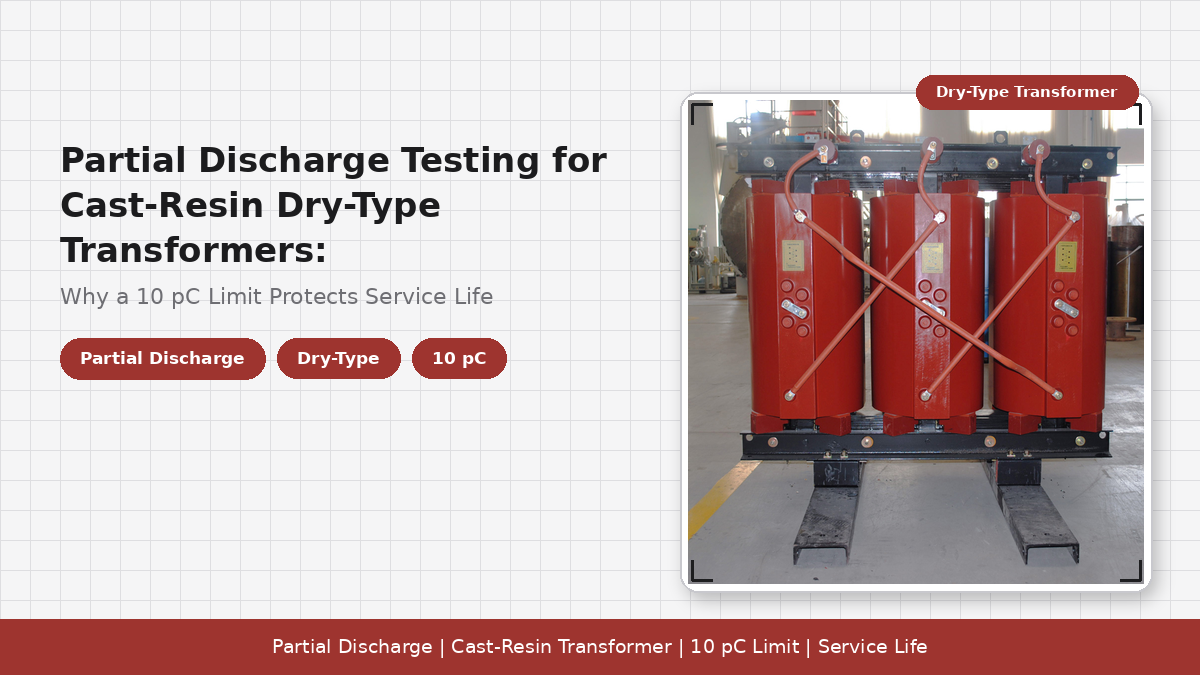
Partial Discharge Testing for Cast-Resin Dry-Type Transformers: Why a 10 pC Limit Protects Service Life
2026-09-14
A field reference for partial discharge testing of cast-resin Dry-Type Transformers — the 10 pC routine-test threshold under IEC 60076-11, what higher levels reveal about insulation quality and service life, and the procurement-side checks buyers can verify before shipment.
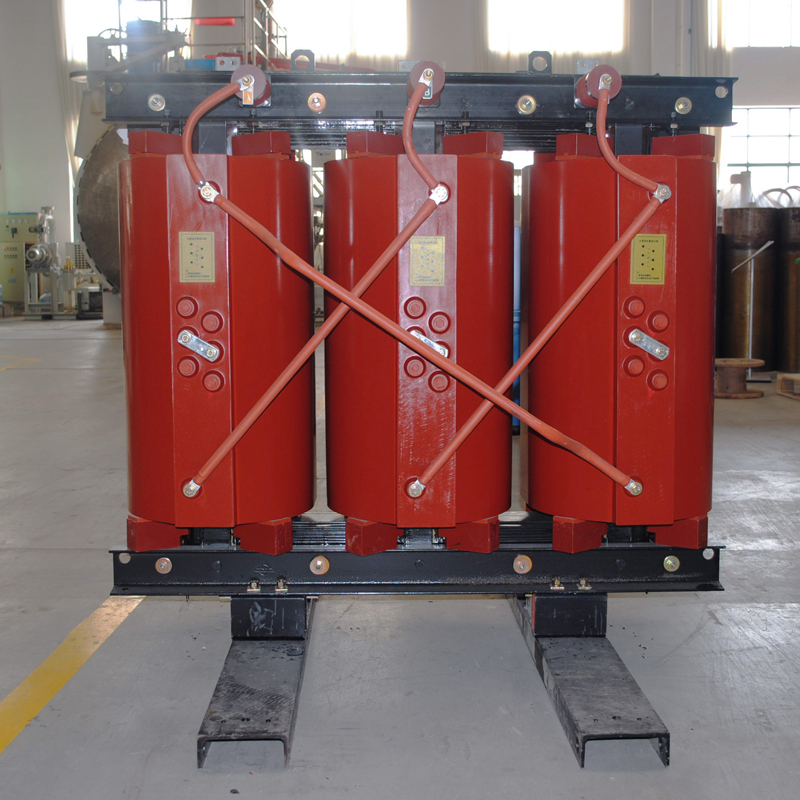
Three years ago a procurement manager at a utility in West Africa called me about a 5 MVA cast-resin transformer that had failed after 14 months of operation. The unit had been purchased from a competing Chinese supplier and shipped with a routine test report that listed the partial discharge level as "≤100 pC" — well above the IEC 60076-11 acceptance limit. The utility's commissioning team had accepted the report without question. By month 14, a phase-to-ground short had developed in the high-voltage winding and the unit was destroyed. Because partial discharge in a cast-resin transformer is a structural indicator of insulation quality — voids in the epoxy resin, delamination between layers, contamination in the casting — a high PD level at routine test does not mean "marginal pass" — it means the insulation was cast with voids that will propagate into full failure within the design service life.
The Tianan factory tour includes the routine-test bays where every SC series transformer is subjected to the IEC 60076-11 induced-voltage test and the partial discharge level is measured and recorded before shipment. Buyers visiting the factory can witness this test in person and verify that the production units measure ≤10 pC — the acceptance ceiling — not the "≤100 pC" value some other suppliers cite as if it were acceptable. This article walks through what partial discharge is, why the 10 pC limit matters, what a high-PD reading predicts about field service life, and what the procurement-side checks look like for buyers specifying cast-resin dry-type transformers.
What Partial Discharge Is — and What It Is Not
Partial discharge is not a defect that appears in service — it is a structural indicator that the insulation was cast with voids, delamination, or contamination that the test detects before the transformer ever leaves the factory. Because cast-resin dry-type transformers are insulated with epoxy resin that is vacuum-cast around the high-voltage winding under controlled conditions, any air pocket, layer separation, or contamination inside the resin creates a small void where the local electric field exceeds the dielectric strength of the air, ionizing the air and producing a measurable discharge event.
Three structural conditions produce measurable partial discharge in a cast-resin transformer:
- Vacuum voids — the vacuum-pressure casting process did not fully evacuate air from the resin flow before cure. Indicates either a vacuum pump performance issue or insufficient resin flow time during casting.
- Delamination — the resin did not bond fully to the winding insulation or between successive casting layers. Indicates surface contamination or insufficient cure temperature profile.
- Contamination — foreign material (moisture, dust, residual cleaning solvent) inside the resin before cure. Indicates cleanroom protocol breach during winding prep.
// Key insight: Partial discharge cannot be repaired in the field. The defect is structural — inside the cured epoxy resin — and field reconditioning cannot access it. A transformer with high PD at routine test must either be returned to the factory for re-casting or replaced.
The 10 pC Threshold Under IEC 60076-11
The 10 pC value cited in the routine test report is not a marketing number — it is the acceptance ceiling defined by the international standard for cast-resin dry-type transformers. Because the IEC 60076-11 routine test specifies that partial discharge must not exceed 10 pC at the induced voltage of 1.1×Um/√3 for the cast-resin class, a transformer measuring above 10 pC at routine test fails the standard — and a transformer passing at exactly 10 pC is at the bottom of the acceptance band, not the top.
| PD Test Type | Test Voltage | Acceptance Level | Purpose |
|---|---|---|---|
| Routine Test PD | 1.1×Um/√3 (sustained 30 min) | ≤10 pC | Production QC check on every unit |
| Type Test PD | 1.1×Um/√3 (sustained 30 min) | ≤5 pC (typical top-tier) | Design qualification on a sample unit |
| Background Noise Floor | Test environment | ≤2 pC | Confirms test environment is properly shielded |
The standard reference is IEC 60076-11 (Power transformers — Part 11: Dry-type transformers), with PD measurement protocol per IEC 60270 (High-voltage test techniques — Partial discharge measurements). Buyers who want to read the standard can purchase it from the IEC webstore or read the reference summary at the IEC official site.
PD Level vs Service Life — The 4× Penalty for Higher PD
The relationship between PD level at routine test and actual service life is roughly inverse — a transformer at 100 pC has a service life expectancy roughly 30-50% shorter than a transformer at 10 pC under identical load conditions. The matrix below maps measured PD level at routine test to typical service life expectation:
| PD Level at Routine Test | Typical Service Life | Insulation Quality | Procurement Action |
|---|---|---|---|
| ≤5 pC | 25-30 years | Top tier — vacuum casting optimized | Approve — flagship quality |
| 5-10 pC | 20-25 years | Acceptable — IEC compliant | Approve — within spec |
| 10-30 pC | 15-20 years | Marginal — at acceptance ceiling | Investigate before approving |
| 30-100 pC | 10-15 years | Below standard — voids likely | Reject — re-cast or replace |
| 100-300 pC | 8-12 years | Significant defects | Reject — structural insulation failure |
| >300 pC | <5 years | Severe insulation defect | Reject — immediate failure risk |
// Service life math: A utility that procures a transformer at "≤100 pC" and operates it for 10-15 years has effectively bought a 50% shorter service life than a transformer at 10 pC. At a transformer unit cost in the mid-five-figure USD range, the cost-per-service-life-year is roughly 2× higher for the high-PD unit than for the compliant unit.
How the PD Test Is Performed
The routine PD test for a cast-resin dry-type transformer follows a five-stage procedure that takes 30-60 minutes per unit.
01
Test Environment Setup
The transformer is placed in a shielded test bay (Faraday cage or equivalent) to keep background electromagnetic noise below 2 pC. The test connection is made via a coupling capacitor that routes the high-frequency PD signal to the measurement instrument.
Background noise target: ≤2 pC · Coupling capacitor: 80-1000 pF · Frequency range: 50-400 kHz
02
Voltage Ramp-Up
The induced voltage on the high-voltage winding is ramped from 0 to 1.1×Um/√3 over 30-60 seconds. During the ramp, the first measurable PD events appear at the partial discharge inception voltage (PDIV) — typically 0.6-0.8×Um/√3 for a high-quality transformer.
For 10kV class: 1.1×Um/√3 = 1.1×10/√3 ≈ 6.35 kV induced voltage
03
Sustained Voltage Hold (30 minutes)
The induced voltage is held at 1.1×Um/√3 for 30 minutes while the PD level is continuously monitored. The 30-minute hold is required by IEC 60076-11 to confirm that the PD level does not escalate over time — a transformer with marginal insulation will show rising PD magnitude during the hold period.
Hold duration: 30 min · Acceptance level: ≤10 pC sustained
04
Voltage Ramp-Down and PD Extinction
The voltage is ramped down to 0 over 30-60 seconds. The partial discharge extinction voltage (PDEV) is recorded — for a high-quality transformer, PDEV is 0.5-0.7×Um/√3, indicating that the discharge events fully cease well before the voltage reaches zero.
PDEV target: 0.5-0.7×Um/√3 for high-quality cast-resin transformers
05
PD Report and Approval
The measurement instrument generates a PD report showing the maximum PD level during the hold, the PDIV, the PDEV, the background noise level, and a waveform screenshot. The report is signed by the test engineer and included in the routine test documentation package that ships with the transformer.
Required output: PD report + waveform capture + test engineer signature
What a Procurement-Side Buyer Should Verify
The PD test report that ships with the transformer is the document a buyer should review line-by-line, not just glance at the acceptance column. Here is what to check before signing off on a shipment:
| Report Field | Acceptable Value | Red Flag |
|---|---|---|
| Measured PD level at 1.1×Um/√3 | ≤10 pC | >10 pC — fails IEC 60076-11 acceptance |
| Background noise floor | ≤2 pC | >5 pC — test environment not properly shielded |
| PDIV (PD inception voltage) | ≥0.6×Um/√3 | <0.5×Um/√3 — insulation weakness |
| PDEV (PD extinction voltage) | ≥0.5×Um/√3 | Significantly below PDIV — polarization memory effect |
| PD level drift during hold | Stable or decreasing | Rising during hold — progressive insulation breakdown |
| Test voltage profile | Documented with timestamps | Missing or generic — suspect report |
| Test engineer signature | Named with credentials | Unsigned or anonymous — unreliable |
// Witness the test on first orders: For first orders or new supplier qualification, witness the PD test in person at the factory or via real-time video feed. The test takes 30-60 minutes per unit and is the most direct verification that the supplier is actually testing what the report claims. The Tianan factory tour includes witnessed routine tests by default for visiting buyers.
5 Common PD-Related Procurement Mistakes
// Mistake 01 — Accepting the report value without comparing to the standard
The PD level on the routine test report is sometimes quoted as "≤100 pC" or "≤50 pC" by suppliers who do not specify the IEC 60076-11 acceptance level. The acceptance level is 10 pC — a transformer at 100 pC fails the standard even if the report looks acceptable at a glance.
Fix: Always check the reported PD level against the 10 pC IEC 60076-11 acceptance ceiling. Anything above 10 pC is a non-conformity that must be investigated or rejected.// Mistake 02 — Ignoring the background noise floor
A reported PD level of 8 pC looks great — but if the background noise floor during the test was 6 pC, the actual PD level above the noise is only 2 pC and the test measurement is not reliable. A high noise floor masks the real PD level and is a sign the test environment was not properly shielded.
Fix: Require the noise floor value to be reported alongside the PD level. Reject any test where the noise floor is more than 30% of the measured PD level.// Mistake 03 — Not requiring the type test report
The type test is performed on a single sample unit during the design qualification phase and establishes the manufacturer's baseline PD performance. Buyers who do not request the type test report miss the reference baseline against which the routine test value should be compared.
Fix: Always request both the type test report (≤5 pC typical) and the routine test report (≤10 pC required). If the routine value is close to the type value, the production casting quality is consistently high.// Mistake 04 — Equating PD level with high-voltage test pass
The applied voltage test (separate from the PD test) checks the transformer's ability to withstand full lightning impulse and short-circuit voltage. A transformer can pass the applied voltage test and still have poor PD performance — the two tests measure different insulation properties.
Fix: Require both the applied voltage test AND the PD test reports. A transformer's insulation quality is judged by the combination, not either test alone.// Mistake 05 — Skipping witness testing to save cost
Buyer visits to witness routine tests add to procurement cost (travel, accommodation, time). Skipping the visit to save cost is a false economy — the cost of one one failed transformer in the field is roughly 50× the cost of one witnessed factory visit.
Fix: For first orders or new supplier qualification, include factory witness testing in the supplier agreement. For repeat orders with established quality history, periodic remote witness (video) is sufficient.Standards Anchor References
For procurement and engineering teams who need to align their PD testing specification with international standards, the relevant anchor documents are:
- IEC 60076-11— Power Transformers — Part 11: Dry-type transformers — the umbrella standard covering all PD and routine test requirements for cast-resin dry-type transformers.[Reference →]
- IEC 60270 — High-voltage test techniques — Partial discharge measurements — the measurement protocol that defines how PD levels are quantified. [Reference →]
- IEC 60076-1— Power transformers — Part 1: General — the parent standard for all power Transformer Testing protocols.[Reference via IEC Webstore →]
- ASTM D149 — Dielectric breakdown voltage of solid electrical insulating materials — the material-level dielectric strength standard relevant for resin formulation verification
Third-party verification of PD testing is provided by Intertek, UL, and DNV — all three provide accredited high-voltage test labs that buyers can engage for independent witness testing or audit of supplier routine test reports. For utility-scale procurement that requires third-party witnessed testing, ASTM International provides the material testing standards referenced in many utility procurement specifications.
Closing Note
If I had to summarize partial discharge testing for cast-resin dry-type transformers in one sentence for a buyer about to place an order: the 10 pC routine-test threshold under IEC 60076-11 is not a quality aspiration — it is the structural acceptance criterion that separates a transformer with a 25-year service life from one that will fail in 10 years, and the routine test report is the document that proves which one you bought.
For a project-specific walkthrough of what the routine test report should look like for your specification, how to interpret the PD waveform data, and what the witness-test protocol looks like at the Tianan factory, the international sales team is available via the dry-type transformer product range.
Specifying Cast-Resin Transformers for a Utility Project?
Send Tianan your kVA rating, voltage class, impedance, and project destination. The sales team will return a quotation including the routine PD test protocol, type test report, and optional witnessed-factory-test scheduling — typically within 3 working days.
VIEW SC SERIES 10kV TRANSFORMER →