
TL;DR — vacuum versus SF6, in five points
- The EU rule prohibits putting SF6 switchgear into operation, not selling or exporting it, in dated voltage bands: up to 24 kV from 1 January 2026, above 24 kV to 52 kV from 2030, above 52 kV to 145 kV and 50 kA from 2028, above that from 2032.
- At 12 and 24 kV, vacuum has already won on physics and now has the regulation behind it — the VT19, VS1 (VTD6), VTD9 and VTD5 vacuum platforms cover that class.
- Above 52 kV there is no vacuum alternative, which is why the 126 kV LW39-126 is still an SF6 breaker and why the EU band dates are later.
- The maintenance difference is the real difference: no gas to monitor, recover or dispose of against a gas regime with trained staff, leak checks and end-of-life recovery.
- Verify the mechanism, not the bottle — on a vacuum breaker the published mechanical life, contact pressure and timing data are the acceptance criteria that replace a gas quality record.
The short answer for a buyer selecting medium-voltage switchgear: the choice is made by the voltage class and the market, not by preference, and by 2026 the European market has already made it for the 12 and 24 kV class. Below 24 kV, vacuum is not an innovative alternative to SF6 — it is the established answer with a published regulation behind it. Above 52 kV, SF6 is not a legacy choice, it is the only commercially available option, and the honest thing to do is plan the compliance date rather than pretend it away.
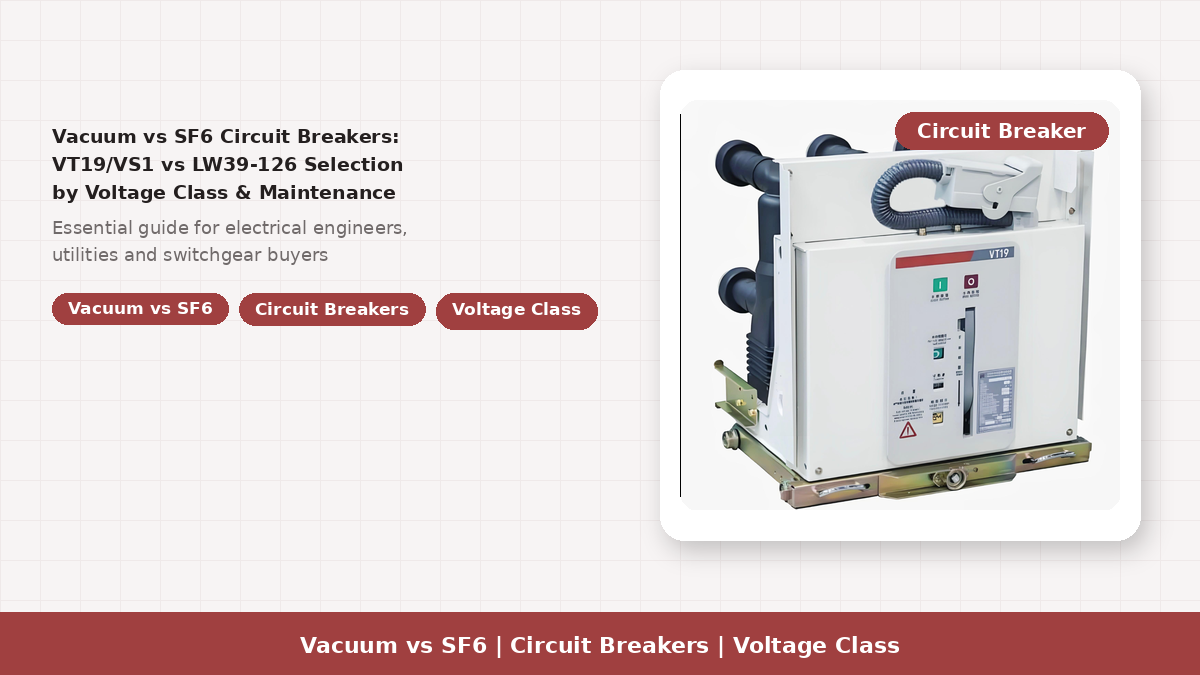
I am International Sales Manager at Ningbo Tianan Imp. & Exp., and I have spent more than fifteen years exporting power equipment across Asia, Africa, the Middle East and South America, which means I spend a lot of my time answering this exact question. Our circuit breaker product family page is the range this guide is written against, the VT19-12(24) indoor vacuum circuit breaker is the machine whose published data I use to show what a buyer should be verifying, and the LW39-126 in the same family is the SF6 126 kV machine that shows where the alternatives stop. To breaker selection support, the contact page is where the one-line scope goes.
What Actually Changed, and on Which Dates
Article 13(9) of Regulation (EU) 2024/573 on fluorinated greenhouse gases prohibits putting into operation switchgear that uses fluorinated greenhouse gases in its insulating or breaking medium, and it does so in four voltage bands with hard dates. From 1 January 2026 the prohibition covers medium voltage up to and including 24 kV. From 1 January 2030 it covers medium voltage above 24 kV up to and including 52 kV. From 1 January 2028 it covers high voltage above 52 kV up to and including 145 kV and up to 50 kA, and from 1 January 2032 it covers high voltage above 145 kV or above 50 kA.
The exception to know about
There is one exception in the same article that a specification should acknowledge: a medium with a global warming potential below 1000 remains permissible where a tender for F-gas-free switchgear drew no bids, or where, in the first two years after a band's date, bids came from only one manufacturer.
The prohibition bites on putting the equipment into operation in the European Union, not on selling it or exporting it. The regulation was adopted under the previous F-gas regulation 2017/1465 and is now consolidated in Regulation (EU) 2024/573, and the practical effect on an export programme is that the European market moves to vacuum while Africa, the Middle East and South America do not have to.
That last point is the one that gets misreported most often, and it matters commercially. SF6 switchgear is not banned from being manufactured or shipped, and it is not banned in the markets where most of our projects run. What a European customer cannot do, from the band date, is switch the equipment on and operate it. Because that pushes the decision onto the project engineer rather than the manufacturer, the specification has to name the market, and a quotation that does not ask where the equipment will be installed has not asked the question that decides the medium.
How the Two Media Actually Interrupt
A vacuum interrupter and an SF6 interrupter both quench an arc, and they do it in ways that have very different consequences for the equipment around them. A vacuum interrupter extinguishes the arc in metal vapour released from the contact material, in a sealed bottle with a very short arcing time and no extinguishing medium at all. An SF6 interrupter quenches the arc in a plasma of fluorine-bearing decomposition products, and the gas is both the insulator and the arc-quenching medium, which is what gives SF6 its extraordinary dielectric performance.
Two consequences of the medium
Two consequences follow, and they drive everything else in this article. A vacuum breaker contains no gas: there is nothing to monitor for quality, nothing to recover at end of life and no decomposition product to manage. And a vacuum interrupter does not wear the way an SF6 contact does, because the arc is very short and confined inside a sealed bottle, so the wear item is the operating mechanism and the insulation, not the interrupting chamber.
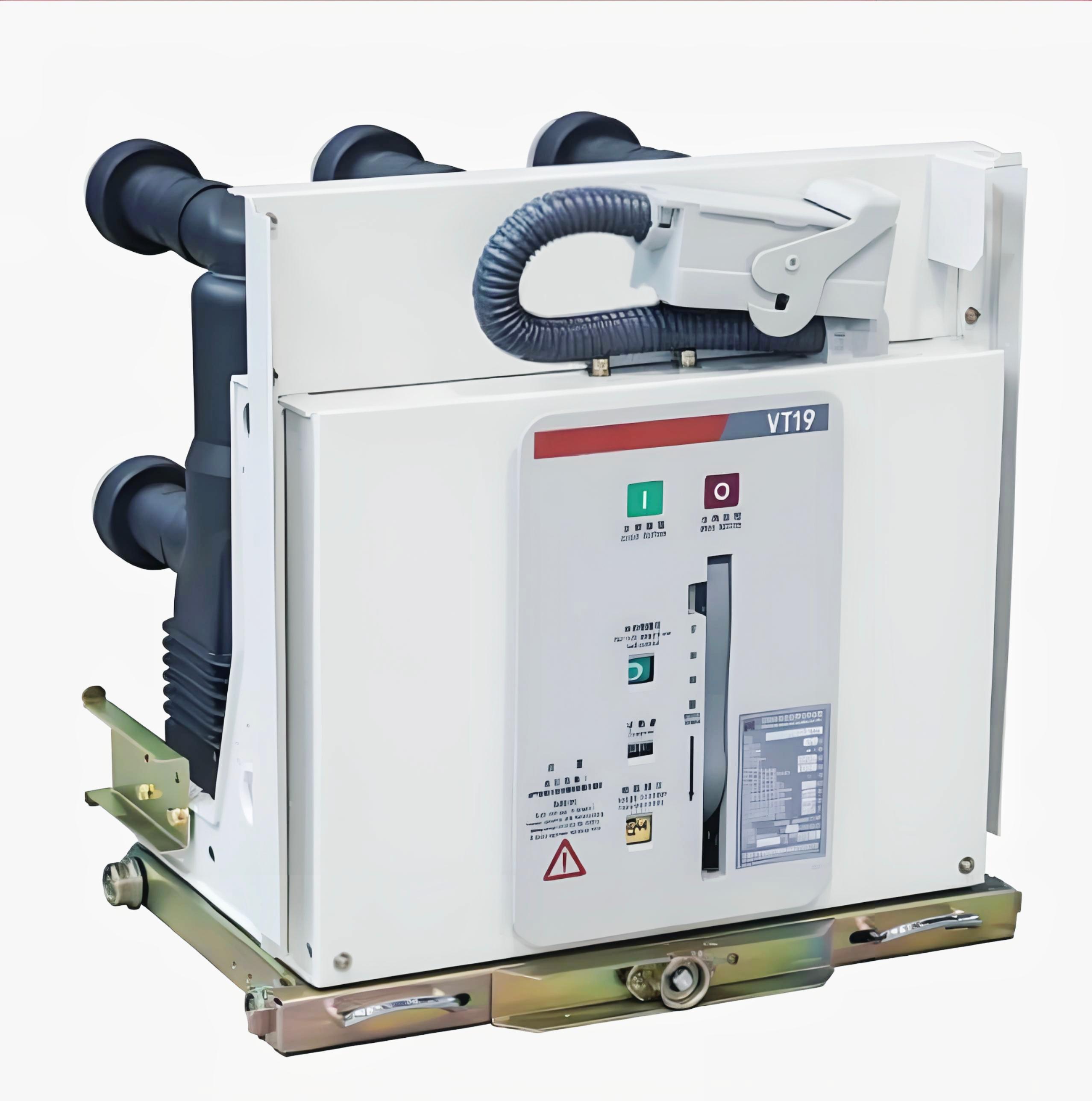
That is why the published VT19 data is mechanical data. The VT19-12/24 is built to IEC 62271-100 alongside GB/T 1984, JB/T 3855 and DL/T 403, with a rated operation sequence of O-0.3s-CO-180s-CO, a mechanical life of 30,000 operations, a clearance between open contacts of 9 ± 1 mm at 12 kV and 13 ± 1 mm at 24 kV, a contact pressure stepping from 2000 N to 5500 N with the current rating, an average opening speed of 0.9–1.3 ms at 12 kV, a bounce time of no more than 2 ms and a rated short-circuit breaking durability of 50 operations at 12 kV and 30 at 24 kV.
Published VT19-12/24 reference data
Rated voltage 12 kV and 24 kV, 50/60 Hz · withstand 75/125 kV power frequency, 42/65 kV lightning impulse
Rated current 630 / 1250 / 1600 / 2000 / 2500 / 3150 / 4000 A · breaking 20 / 25 / 31.5 / 40 / 50 kA · making 50 / 63 / 80 / 100 kA
Short circuit 4 s · breaking operations 50 at 12 kV, 30 at 24 kV · mechanical life 30,000 operations (20,000 at 4000 A)
Service conditions +40 to −15 °C · altitude ≤1000 m at 12/24 kV, ≤2000 m at 40.5 kV · earthquake intensity below grade 8
Layout integrated operating mechanism and breaker body, front-and-back split, fixed or trolley withdrawable, phase spacing 150 / 210 / 275 ±1.5 mm, cabinet widths 550 to 1000 mm
Voltage Class: Where Vacuum Wins and Where SF6 Still Wins
In the medium voltage class the choice has effectively been made, and in the high voltage class it has not. Our own catalogue makes the shape of the market obvious: the indoor vacuum platforms are the VT19-12/24, the VS1 (VTD6)-12(24), the VTD9-12D, the VT19-40.5 and the VTD5-(12/24)40.5 vacuum breaker for gas-insulated switchgear, while the SF6 platform in the family is the LW39-126, an outdoor 126 kV class machine.
That is the honest picture of the technology, and it is the reason the EU band dates are staggered. Because there is no vacuum alternative at 126 kV class, choosing above 52 kV in 2026 is not a choice between two media — it is a choice between an SF6 breaker with a compliance plan and a technology that does not yet exist at that rating. The regulation reflects that reality, with later dates and exemptions for the highest bands.
The selection in practice
For a buyer inside the 12 and 24 kV window in Europe, the guidance is unambiguous: specify vacuum. Our environmentally friendly switchgear line and the vacuum platforms in the circuit breaker family are built for exactly that, and the VT19-12/24 is the example to look at. For a buyer in a market where the F-gas regulation does not apply, the decision is about lifetime cost, maintenance capability and local service, which is a different conversation and one we are happy to have.
Maintenance: The Part Buyers Misjudge
The maintenance argument is usually made as "vacuum is maintenance free", and that is not quite true — it is maintenance free in the parts that are expensive to manage, not in the parts that need attention. A vacuum breaker still needs the operating mechanism inspected and lubricated, the spring charging checked, the insulation and interlocks verified, and the mechanism wear components replaced against the published mechanical life.
What it does not need is the SF6 regime. That regime includes periodic gas quality monitoring, because decomposition products accumulate with every interruption and are corrosive and toxic, and it includes leak checking duties, and it includes the end-of-life chain: the gas has to be recovered, recycled or destroyed by a specialist contractor, and in the European Union it carries a financial guarantee obligation tied to the quantity of gas placed on the market.
Compare the two maintenance regimes as line items, not as adjectives: on a vacuum breaker the maintenance is mechanical, scheduled and within the plant's own capability; on an SF6 breaker it is a specialist service with specialist equipment, and it continues past the end of the equipment's working life.
A second SF6-specific cost sits earlier in the chain and is forgotten more often: gas handling at installation and commissioning requires trained people and the right equipment, which is why the first SF6 fill on a project carries a cost the equivalent vacuum installation does not have. Because the total cost of ownership of an SF6 breaker therefore includes a service and disposal tail that a vacuum breaker simply does not have, the comparison has to run over the full service life and not over the purchase order.
What the Medium Changes in the Switchgear Layout
The interrupting medium decides the architecture of the bay, and that has consequences long before anyone plugs the breaker in.In an SF6 design the circuit breaker, the disconnector and the Earthing Switch sit inside a gas compartment, and the whole assembly is a sealed gas-insulated unit described byIEC 62271-202 for equipment up to 52 kV and IEC 62271-203 above it.
In a vacuum design the interrupter is a sealed bottle and the rest of the bay is a conventional air-insulated metal enclosure described by IEC 62271-200, with the common clauses in IEC 62271-1. On the VT19 the operating mechanism and the breaker body are integrated in a front-and-back split structure with reliable interlocking, and the unit can be fixed or combined with a trolley to form a withdrawable unit, which matters because a withdrawable unit is the one you can take to the workshop instead of working on it in the cubicle.
That last point is worth a paragraph of its own, because it is a maintenance decision dressed as a mechanical one. Withdrawable design turns a cubicle repair into a workshop job, and it is a differentiator that belongs in the specification rather than in a preference, especially where the site is remote or the outage window is short.
The Selection Matrix by Voltage Class
Pulling it together, this is the selection I would walk a project engineer through, with the published band dates and the questions to close in each row.
| Voltage class | Dominant medium | EU put-into-operation date | What to verify |
|---|---|---|---|
| Up to 12 kV | Vacuum, effectively complete | 1 January 2026 | Mechanical life, contact pressure, withdrawal facility, the European tender record |
| 24 kV | Vacuum, effectively complete | 1 January 2026 | Phase spacing and cabinet width against the switchgear, seismic class, altitude derating |
| 40.5 kV | Vacuum available, GIS variants as vacuum interrupters in a gas bay | 1 January 2030 | Whether the project is a gas-insulated bay with a vacuum interrupter or a vacuum bay |
| 52 kV to 145 kV up to 50 kA | SF6 remains the only mature option | 1 January 2028 | The compliance plan, the gas recovery route, and the exemption conditions in Article 13(11) |
| Above 145 kV or above 50 kA | SF6, with the latest band date | 1 January 2032 | Long-term asset strategy, the service and disposal chain, and the technology roadmap |
One caution on the first two rows. Because the ban is on putting the equipment into operation, an existing SF6 installation in a 12 or 24 kV substation is not made illegal on 1 January 2026 — but the replacement decision for the next capital cycle has effectively already been made by a date on a calendar, and the sooner that is recognised the cheaper it is.
The Documents to Ask For
Ask for the compliance file before you ask for the price, because the file is what tells you whether the machine can be put into service in the destination market. For a breaker in this class that means the standards it is built to — IEC 62271-100 for the breaker itself, IEC 62271-1 for the common clauses, and IEC 62271-200 for an air-insulated metal-enclosed bay or IEC 62271-202 and IEC 62271-203 for a gas-insulated one — with the rated data, the type test reports and the service conditions.
On the VT19-12/24 the service conditions are published, and they are the ones to check against your site rather than the ones to admire in a brochure: ambient temperature from +40 °C to −15 °C, daily average relative humidity at or below 95 %, altitude up to 1000 m for the 12 and 24 kV versions and up to 2000 m for the 40.5 kV version, and earthquake intensity below grade 8. Because altitude derating is a real constraint rather than a footnote, and because a substation at 2,000 m in a seismic zone invalidates a standard service condition, the site data has to be sent with the enquiry and the answer written down.
The mechanism data to ask for
Also ask for the mechanism data, because that is what your maintenance team will work with: mechanical operations, contact pressure by rating, timing values, interlocks, lubrication and inspection intervals, and the spare parts list with the mechanism consumables separated from the interrupter, which on a vacuum breaker is a very short list.
Eight Questions to Put in Your Breaker Enquiry
Send these eight with the enquiry and the answers will tell you more about the supplier than the quotation will.
- Where will the equipment be put into operation, and which F-gas band does that put it in?
- Which interrupting medium do you propose, and what is the lead time for the alternative if the market changes?
- What are the rated voltage, current, breaking current, making current and operating sequence of the exact variant offered?
- What are the mechanical life in operations, the contact pressure, the timing values and the interlocking arrangement?
- Is the unit fixed or withdrawable, and what does the trolley travel and the cubicle width mean for my switchgear?
- What are the standards, the type test reports and the service conditions, and how do they match my site?
- What is the maintenance plan for this configuration, and who is trained and equipped to carry it in my country?
- What is the end-of-life route for the equipment and, if SF6, for the gas?
Frequently Asked Questions on Vacuum and SF6 Circuit Breakers
1. Is SF6 still legal to sell and export in 2026?
Selling and exporting are not what the EU rule prohibits. Article 13(9) of Regulation (EU) 2024/573 prohibits putting into operation switchgear that uses fluorinated greenhouse gases in its insulating or breaking medium, and it does so in voltage bands, from 1 January 2026 up to and including 24 kV. A manufacturer may therefore still build and export SF6 switchgear, but a European customer who installs it from the band date operates equipment it is not permitted to put into service, so the practical effect on an export programme is that the European market moves to vacuum while other markets do not.
2. Which voltage classes does the EU F-gas prohibition cover?
Four bands: up to and including 24 kV from 1 January 2026, above 24 kV up to and including 52 kV from 1 January 2030, above 52 kV up to and including 145 kV and up to 50 kA from 1 January 2028, and above 145 kV or above 50 kA from 1 January 2032. Article 13(11) also keeps a medium with a global warming potential below 1000 permissible where a tender for F-gas-free switchgear drew no bids, or where in the first two years after a band date only one manufacturer bid.
3. Is a vacuum circuit breaker really maintenance free?
The interrupter is, and that is the point. There is no gas to monitor, no gas to recover, no decomposition product to manage and no end-of-life disposal obligation, so the maintenance on a vacuum breaker is mechanical: the operating mechanism, the lubrication, the insulation and the interlocks. What replaces the gas record is the mechanical life and the contact data, and on the VT19-12/24 those are published as 30000 operations, a contact pressure of 2000 to 5500 N and a clearance between open contacts of 9 plus or minus 1 millimetres at 12 kV.
4. Why does SF6 still dominate above 52 kV?
Because there is no vacuum alternative at that voltage class yet. Vacuum interrupters are commercially proven up to the medium voltage range and into the lower high voltage range, but a 126 kV class outdoor breaker such as the LW39-126 is still built around SF6, and that is why the EU regulation carves out later dates and permits exemptions for the highest voltage bands. Choosing above 52 kV in 2026 is therefore not a choice between two media, it is a choice between an SF6 breaker with a compliance plan and a technology that does not yet exist at that rating.
5. What does the choice of interrupting medium change in the switchgear layout?
In an SF6 design the breaker, disconnector and earthing switch sit inside a gas compartment and the whole bay is a sealed gas-insulated assembly, which is described by IEC 62271-202 and IEC 62271-203. In a vacuum design the interrupter is a sealed bottle and the rest of the bay is conventional air-insulated metal enclosure described by IEC 62271-200, and on the VT19 the operating mechanism and the breaker body are integrated in a front-and-back split structure, with reliable interlocking and either fixed installation or a trolley for a withdrawable unit.
6. How do I verify the mechanical condition of a vacuum breaker?
Through the published mechanical characteristic table rather than a gas record. On the VT19-12/24 that means the clearance between open contacts of 9 plus or minus 1 millimetres at 12 kV and 13 plus or minus 1 at 24 kV, the over-travel of 3.5 plus or minus 0.5, the contact pressure of 2000 to 5500 N by rating, the average opening speed of 0.9 to 1.3 milliseconds at 12 kV, the bounce time of no more than 2 milliseconds, and the mechanical life of 30000 operations, and each of these is a value a technician can measure rather than infer.
7. Does the F-gas regulation make a vacuum breaker cheaper?
Not necessarily, and it is worth separating the two effects. The capital price of the two technologies is close enough that it should not decide the specification, while the operating and end-of-life obligations are not close: an SF6 installation carries gas monitoring, trained personnel, recovery and recycling equipment at end of life, and in the European Union a deposit obligation and leak-check duties on the gas itself. Where the two differ sharply is total cost of ownership over thirty years, and that is where the decision should be taken.
Get Breaker Selection Support
Send us the rated voltage, the rated current, the short-circuit breaking current, the installation site and the country, and I will come back with the platform that fits, the data sheet behind it, and the compliance position for that market. If you are comparing against an installed SF6 base, tell me the utilisation and the outage windows as well, because the answer for a substation running three shifts is different from the answer for a rural feeder with a twelve-hour window.
Our circuit breaker product family page carries the vacuum and SF6 platforms side by side, the VT19-12(24) indoor vacuum circuit breaker page carries the full published parameter tables used in this guide, and for breaker selection support the contact page is where the scope goes — Ningbo Tianan Imp. & Exp. Co., Ltd., 3rd Floor, Building B7, No.999 Yangfan Road, High-Tech Zone, Ningbo, and we answer technical questions with the data rather than with a brochure.
Vacuum or SF6 — which one, and until when?
Request breaker selection support